Night-time safety: the hours when most things go wrong
Dim warm lighting on the bed-to-bathroom route, a bed sensor that notices someone has not returned, and the notification setting that quietly disables everything.
Dim warm lighting on the bed-to-bathroom route, a bed sensor that notices someone has not returned, and the notification setting that quietly disables everything.
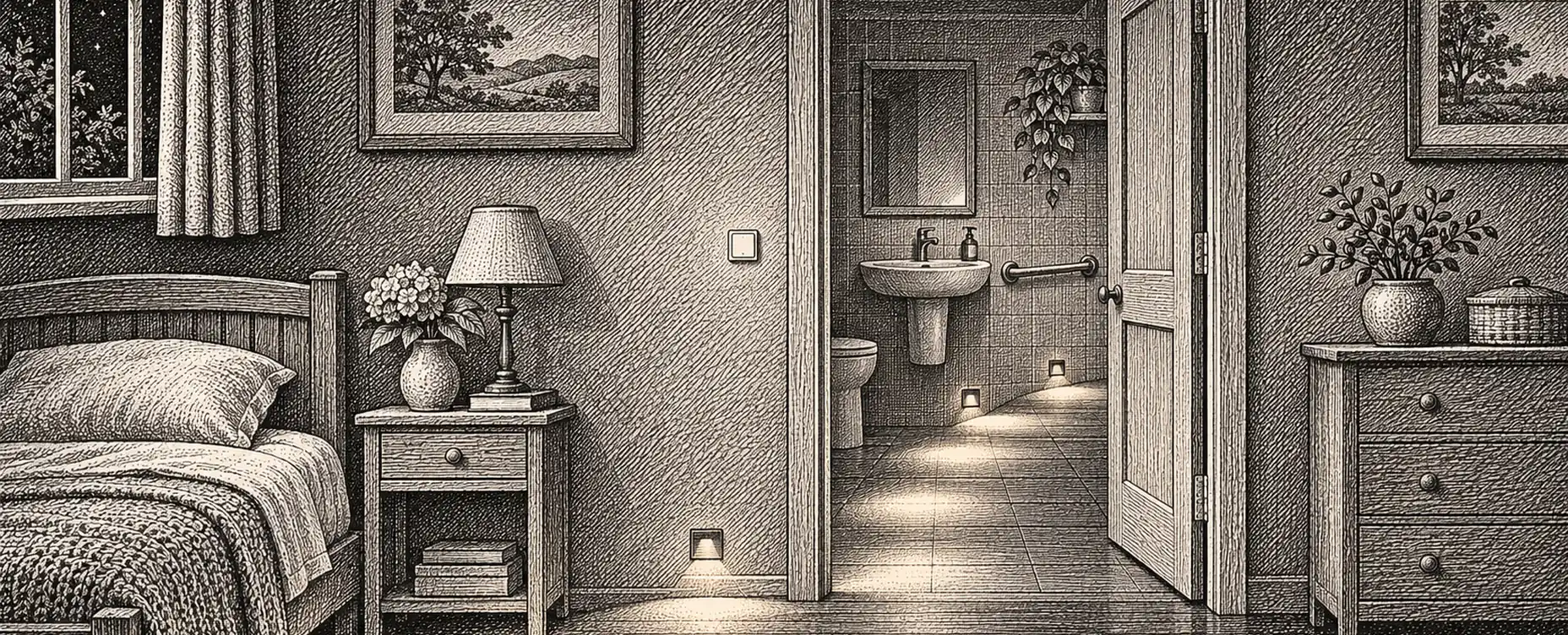
Ask anyone who works in home care when things go wrong and the answer is consistent: at night. The house is dark, the person is disoriented in the first seconds after waking, judgement is poorer, nobody else is awake, and a problem that would be trivial at two in the afternoon becomes serious at two in the morning.
Night-time is also where home automation is at its most useful, because the interventions are simple, cheap and require nothing of the person at all.
This single route deserves more attention than everything else combined. It is walked in darkness, often several times a night, by someone who has just woken and whose eyes have not adjusted. It frequently involves a doorway, a change of floor surface, and sometimes stairs.
The instinct is to make it bright. That is wrong on two counts: bright light destroys the night vision the person is relying on, and it wakes them properly, which makes returning to sleep harder.
What works is dim, warm, low-level light triggered by motion. Five to ten per cent brightness in a warm colour is enough to see edges and thresholds. Mount the light low — skirting level or a plug-in night light — so it illuminates the floor rather than shining into the eyes. Extend the timeout generously, because a fifteen-second hallway timer that plunges someone into darkness mid-journey is worse than no automation.
A lit bedroom and a dark hallway simply moves the hazard. Sensors and lights at each stage — bedside, hallway, bathroom door — with each triggering the next. If the route includes stairs, light them from both ends with a long timeout.
Restrict the night behaviour to the route. A motion sensor that brings the kitchen and living room up at three in the morning is disorienting and will get disabled.
A pressure sensor under the mattress reports whether someone is in bed. It sounds trivial and it enables the most valuable alerts in this category.
Out of bed for an unusually long time. If someone normally returns within ten minutes and has been up for forty-five at three in the morning, that is worth a check. This is the closest thing to fall detection that requires no fall detection algorithm at all.
Automatic path lighting. Leaving the bed can light the route directly, which is more reliable than waiting for a motion sensor to notice movement in a dark room.
Not in bed at all. If the bed was not occupied by two in the morning, something is unusual. Worth an informational note rather than an alarm.
Bed sensors are unobtrusive, require nothing to be worn, and are among the cheapest devices discussed anywhere in this category.
An external door opening in the small hours is one of the few things that justifies waking a family member. For someone with dementia in particular, leaving the house at night is a serious risk, and a door contact is the simplest possible detection.
Handle it carefully, though. The response should be a phone call rather than an alarm sounding in the house, which would frighten and disorient the person. And a door that is locked to prevent someone leaving raises significant legal and ethical questions about deprivation of liberty — that is not a decision to make with a smart lock and good intentions.
Bedrooms often run colder than the rest of the house, heating is frequently set back at night, and older people are more vulnerable to cold with less awareness of it. A bedroom temperature sensor with a low-temperature alert catches something genuinely harmful that nobody will report.
Two useful automations. Hold a floor temperature overnight rather than a deep setback — the cost difference is small and the risk reduction real. And if the room drops below a threshold, boost heating and notify, rather than simply logging it.
A small number of people find night-time silence itself distressing, particularly after bereavement or in early dementia. Two things help without any monitoring at all: a bedside control that turns on a lamp and a radio in one press, and a spoken clock — a device that says the time on request removes the need to find glasses and a phone at four in the morning to answer a simple question.
These are small comforts and they reduce night-time journeys, which is the actual safety benefit.
Mornings matter too, and they are easier. A gradual light that begins twenty minutes before the usual waking time helps with the disorientation of waking in a dark room in winter, and does it without an alarm. Bringing the bedroom up to temperature before the person gets out of bed removes a real disincentive to getting up at all on a cold morning, which matters more than it sounds for someone whose mobility is already limited.
The morning is also when the reassurance signal arrives. As covered in passive monitoring, the kettle being used is the single best indicator that the night passed without incident — which means the most valuable thing your night-time system produces is often a quiet confirmation the next morning that nothing happened at all.
Do not use bright automatic lighting. Covered above, and the most common mistake.
Do not put a camera in a bedroom. There is almost no case in a private home that justifies it. If night-time falls are the concern, radar detects posture without producing an image.
Do not sound alarms in the house overnight for anything other than fire or carbon monoxide. Waking a disoriented person with a siren creates the very confusion you were trying to protect against.
Do not rely on notifications reaching a sleeping relative. If a night alert genuinely requires a response, it needs to be loud enough on the recipient's phone to wake them, sent to two people, and tested. Most phones silence notifications overnight by default, which quietly disables the whole system at precisely the hours it was built for.
Every item there is inexpensive, none of it requires the person to wear, charge or operate anything, and the first item alone prevents more harm than most of the technology sold for this purpose.