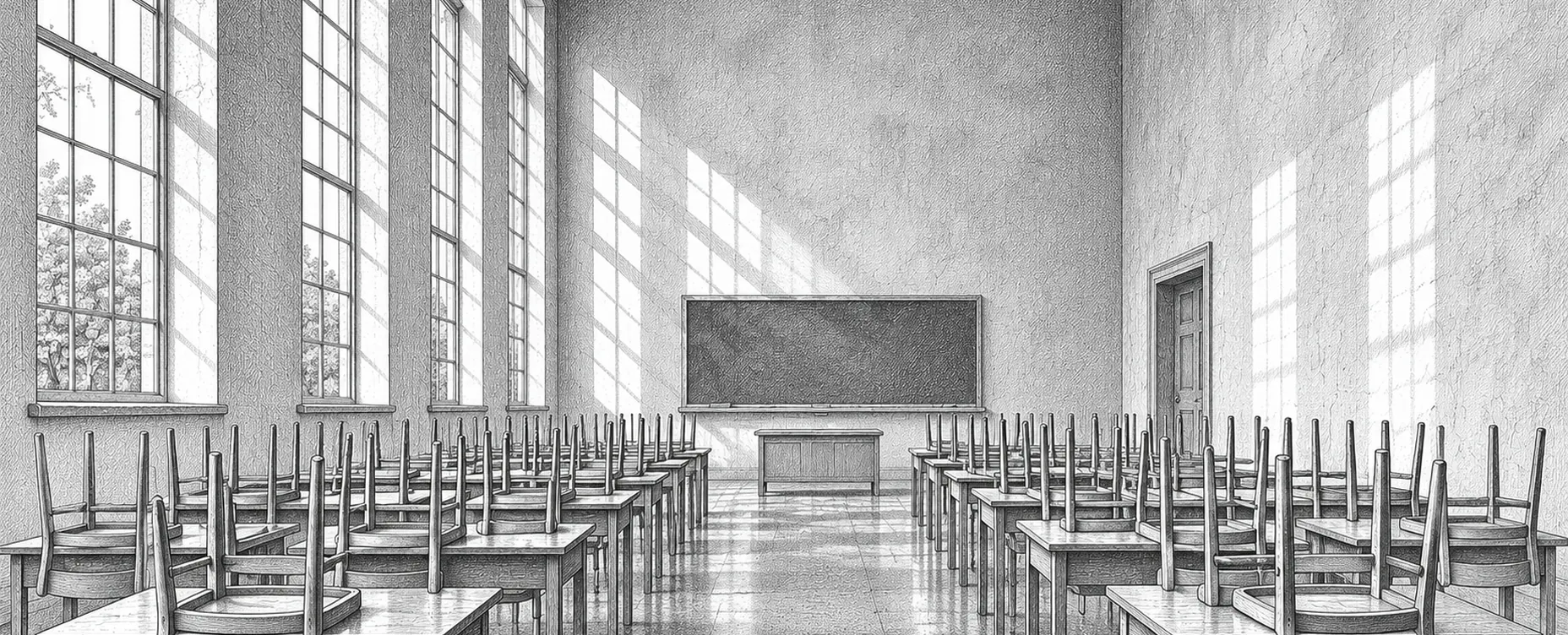
Classroom acoustics are the most under-recognised problem in school buildings. A room where children cannot reliably hear the teacher affects every lesson taught in it, and unlike lighting or temperature, nobody notices it as a fault — the children simply concentrate harder, tire faster, and miss words.
The research here is unusually clear, and the interventions are unusually cheap.
Why children need better acoustics than adults
This is the point that changes how people think about it.
Adults understand speech in poor conditions by filling gaps from context and vocabulary. Children cannot do this to the same extent, and the ability develops gradually through to the mid-teens. Younger children therefore need a substantially better signal-to-noise ratio than an adult to achieve the same comprehension.
Three groups need better still, and every classroom contains some of them: children with hearing loss, including the very common temporary loss from glue ear; children learning in a second language; and children with attention or language processing differences.
So a room that an adult inspector judges acceptable may be measurably inadequate for the children in it. That is the core finding, and it is why guidance for schools sets stricter limits than for offices.
The two numbers that matter
Reverberation time, written T₂₀ and measured in seconds, describes how long sound takes to decay in a room. High reverberation smears each word into the next, which is why a hard-surfaced classroom sounds echoey and is tiring. National school building standards typically require something in the region of 0.6 to 0.8 seconds for a normal classroom, and lower for spaces used by children with hearing impairment.
Ambient noise level, in dB(A), describes the background against which the teacher must be heard. School guidance commonly sets limits around 35 dB(A) for a classroom, which is quieter than most people imagine and considerably quieter than many real classrooms achieve.
Together they determine intelligibility. A room can meet one and fail the other, and a noisy room with short reverberation is often more usable than a quiet room with a long one.
Where the noise comes from
Usually not from outside, which is what people assume.
Building services. Ventilation fans, fan coil units, projectors and interactive display cooling fans. A projector fan running at 45 dB directly above the teaching position is a serious and extremely common problem, and it is entirely fixable by specification.
The children themselves, amplified by reverberation. This is the feedback loop that matters: a reverberant room makes children louder, because they cannot hear each other, which makes the room noisier, which makes everyone louder. Reducing reverberation reduces noise.
Adjacent spaces. A corridor, a hall, a music room or a sports hall on the other side of a lightweight partition. Sound transmission between spaces is a design matter and expensive to fix later.
Outside. Traffic, playgrounds, and increasingly mechanical plant. This is where the tension with ventilation appears, because opening windows for carbon dioxide control admits noise.
Furniture. Chairs and table legs scraping on a hard floor, which in a room of thirty children is continuous.
The cheap fixes, which are surprisingly effective
In order of value per pound.
Felt pads or tennis balls on chair and table legs. Trivial, almost free, and it removes a continuous noise source. Schools that do this notice.
Soft furnishings. Curtains, a carpeted reading corner, fabric-backed display boards, and displayed children's work on the walls all absorb sound. A classroom with bare hard walls, a hard floor and a hard ceiling is the worst case, and covering even part of it helps.
Absorptive ceiling tiles or panels. The single most effective physical intervention, because the ceiling is the largest uninterrupted surface and the one nobody is using. Class A absorbers across most of the ceiling can transform a room, and it is a modest project during a holiday.
Wall panels at the rear, which address the reflection back towards the teacher.
Move the noisy equipment. A projector with a loud fan can often be relocated, replaced with a quieter model, or swapped for a display with passive cooling. Check the noise specification of anything you buy for a classroom, which almost nobody does.
Rearrange the room. Reducing the distance between teacher and the furthest child improves the signal-to-noise ratio at no cost, and a horseshoe or cluster layout is usually better acoustically than rows.
Soundfield systems, and when they help
A soundfield amplification system uses a teacher's microphone and distributed speakers to raise the teacher's voice a few decibels evenly across the room.
The evidence for these is reasonably positive, particularly for younger children and for children with hearing difficulties, and teachers report less vocal strain — which is itself a genuine occupational issue.
Two important caveats. They do not fix a reverberant room; amplifying a voice in a room with a long reverberation time amplifies the smearing too, so absorption comes first. And they need to be used, which means a microphone that is comfortable, charged and habitual — a system in a cupboard achieves nothing.
Our order: measure, absorb, remove noise sources, then consider amplification.
The ventilation tension, resolved
Classroom carbon dioxide control usually means opening windows, and opening windows admits noise. This is a real conflict and it has answers.
Acoustic trickle vents and attenuated louvres provide airflow with substantially less noise ingress than an open window.
Mechanical ventilation with quiet specification, which means checking the noise figure at the design airflow rather than at minimum — a unit quoted quiet at low speed may be loud at the rate actually needed.
Purge between lessons rather than continuously: open wide during changeover, closed during teaching. Carbon dioxide data makes this manageable, and it is a free and effective compromise.
Do not simply close the windows. The evidence on carbon dioxide and cognitive performance is strong enough that trading air quality for quiet is not a good bargain.
Halls, dining rooms and sports halls
The large spaces are acoustically the worst in a school and are used for assemblies, performances, examinations and lunch, all of which depend on being heard.
Dining halls are the clearest case. A hard-surfaced hall with two hundred children produces a level that is genuinely unpleasant and pushes everyone louder, and the same feedback loop applies. Absorption on the ceiling and upper walls is the answer, and it is one of the more visible improvements a school can make — staff notice immediately.
Sports halls need absorption that survives being hit by a ball, which means impact-resistant panels rather than standard tiles. Worth specifying properly rather than improvising.
Assembly halls used for speech need shorter reverberation than halls used for music, which is a genuine design conflict. Where a hall does both, variable absorption — curtains that can be drawn or retracted — is the established solution.
Examination use is worth thinking about, because an intrusive noise during an examination is both a welfare and a fairness issue, and it is usually a ventilation fan or an adjacent corridor.
What we would do
- Measure ambient noise in a sample of classrooms, empty and occupied, and note the peaks.
- Identify the loudest fixed source — usually a fan — and deal with it.
- Felt pads on every chair and table leg.
- Add absorption to the ceiling in the worst rooms, during a holiday.
- Display work on hard walls, add curtains and a soft area.
- Rearrange for shorter teacher-to-child distances.
- Specify a noise figure for every piece of equipment bought for a classroom from now on.
- Then consider soundfield systems, and resolve ventilation with attenuated vents and purge between lessons.
Items three and four together cost very little and change how a room works. Item seven costs nothing and prevents the problem returning with the next projector.