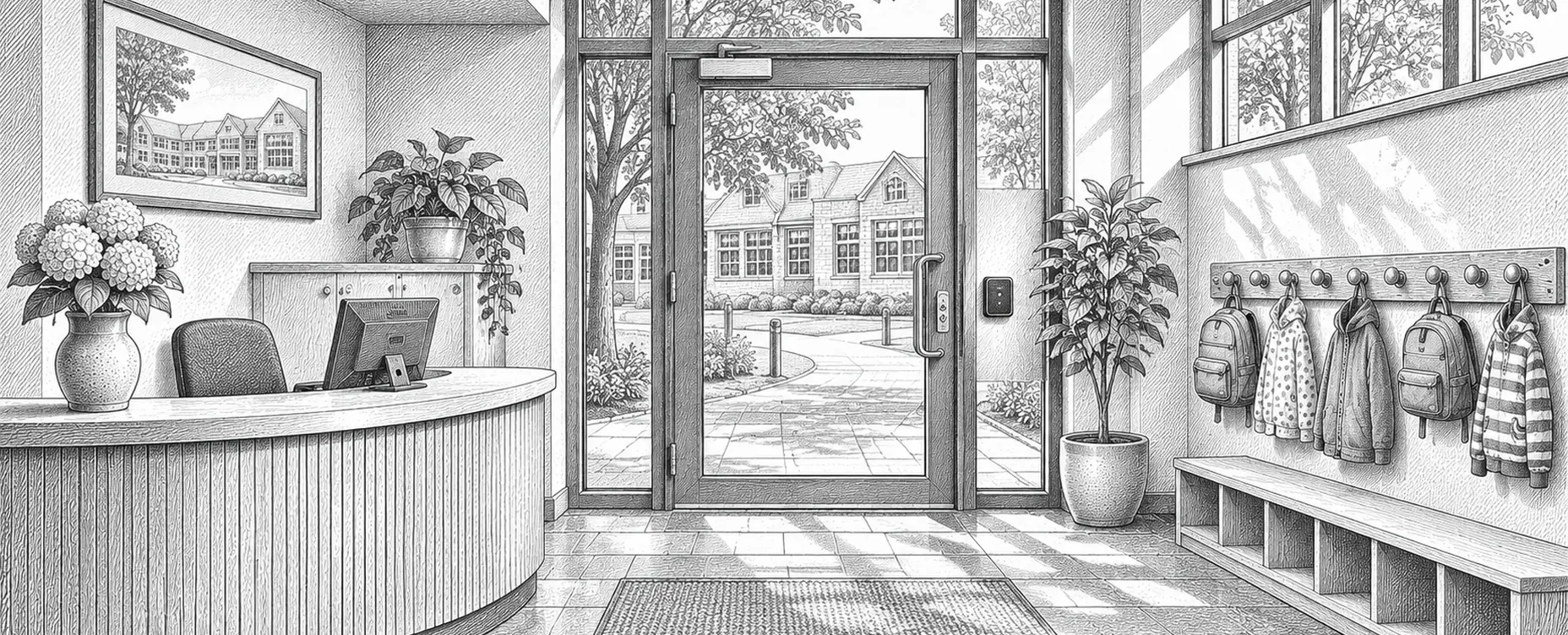
Access control in a school carries weight that it does not carry in an office. The people inside are children, the organisation has statutory safeguarding duties, and the consequences of getting it wrong run in two directions: someone who should not be in the building, or a child who cannot get out of it.
This article deliberately stays on the technical and organisational ground and points repeatedly at where professional advice is required. That is not caution for its own sake — several of the decisions here are governed by regulation and by safeguarding policy, and a smart home article is not the right authority on them.
What access control in a school is actually for
Three distinct purposes, frequently conflated, each needing something different.
Knowing who is in the building. Primarily a fire safety and safeguarding requirement: in an evacuation somebody has to account for every person. This is about records, not locks.
Controlling who can enter. Keeping the site secure during the day, and managing visitors, contractors and out-of-hours users.
Controlling movement within the site. Restricting access to specific areas — a science prep room with chemicals, a plant room, a server room, records storage.
Being clear which purpose a given measure serves prevents the common mistake of buying a locking system to solve a records problem.
The single most important constraint
This constraint shapes the whole design. It means the honest answer is that access control secures a school against people coming in, and must never restrict people going out.
Credentials that suit a school
Staff
Cards or fobs are the practical choice: cheap, easy to issue and revoke, no phone dependency, and they generate meaningful per-person records. Ask specifically for encrypted card technology rather than older unencrypted formats, which can be cloned with inexpensive equipment.
Visitors and contractors
Time-limited credentials that expire without anyone having to remember to revoke them. This matters more in schools than elsewhere because of the volume of visitors and the safeguarding requirement to know who is on site and whether they have been checked.
Students
This needs care, and the answer depends on age and on national norms. Cards used for entry, catering and library work well in secondary settings. Biometrics — fingerprints, facial recognition — are a different matter entirely: several countries restrict or effectively prohibit biometric processing of children, and in the EU biometric data is a special category requiring a strong legal basis and usually explicit consent, with a workable non-biometric alternative offered. Our position is that biometrics in schools should be avoided unless there is a compelling case, professional legal advice, and a genuine alternative for families who decline.
Knowing who is on site
This is where technology helps most straightforwardly, and it is a safeguarding and fire matter rather than a security one.
A visitor management system that records arrival, purpose, who is being visited and departure, and prints a badge, is now standard practice and inexpensive. Integrating it with the fire evacuation list means the roll call at the assembly point includes visitors and contractors, which a paper book in reception does not reliably achieve when reception is the room you have just evacuated.
For staff and students, entry records help but should be treated carefully. They are useful for a fire roll call and for safeguarding; using them to monitor punctuality is a different purpose with different obligations and will damage trust quickly.
Lockdown: what technology can and cannot do
Many schools now have a lockdown procedure for an external threat, and the question of whether it can be triggered technologically comes up regularly. A few things are worth stating plainly.
The procedure comes first, and it is not a technology decision. Lockdown planning should be developed with your local police service or equivalent authority, and in most countries there is specific guidance for schools. Technology implements a plan; it cannot substitute for one.
What technology does well: rapid, unambiguous communication. A single action that sends a message to every classroom display, sounds a distinct alert tone different from the fire alarm, and notifies designated staff and the office. Speed and clarity of communication is the genuine contribution.
What technology must not do: lock people in. Any automatic locking that could impede escape conflicts directly with fire requirements. Where a lockdown plan involves securing internal doors, that is a decision for a fire risk assessment and the relevant authorities, and the mechanisms used are specified accordingly — not configured in a hub.
Two alarms must never be confusable. A lockdown signal that sounds like a fire alarm will send children outside during exactly the event where they should stay inside. Distinct tones and distinct messaging, rehearsed, is a life-safety requirement.
Cameras: proportionate and carefully placed
Cameras in schools attract legitimate scrutiny, and the sensible approach is narrow.
Entrances, perimeters, car parks, bike stores and areas with a history of problems are generally defensible. Classrooms, changing rooms, toilets and staff rooms are not, and in many jurisdictions a camera in a toilet or changing area is straightforwardly unlawful.
Practical requirements: clear signage; a documented purpose; a retention period with automatic deletion; restricted access with a log of who viewed what; and privacy masking for anything beyond your boundary. Where recording covers children, the data protection obligations are heightened, and most education authorities have specific policies — follow those rather than general commercial guidance.
Practical realities of a school site
Doors are used constantly. Hardware in a secondary school takes an order of magnitude more use than in an office. Specify commercial-grade equipment; consumer smart locks will not survive.
Everything gets tested by students. Assume any device within reach will be experimented with. Mount high, choose robust hardware, and do not rely on anything that fails open in an interesting way.
The IT department is a partner, not an obstacle. School networks are locked down for safeguarding reasons. Involve the IT provider at the design stage, expect to use a separate network segment for building devices, and accept that this is reasonable.
Sites are large and often old. Wireless coverage across a Victorian building with thick walls and separate blocks is a real engineering question, and it is worth surveying rather than assuming.
A defensible starting point
- Get the fire position confirmed in writing for any door you intend to change, before buying anything.
- Visitor management first. Highest safeguarding value, lowest controversy, integrates with the evacuation list.
- Staff cards on external doors, with per-person credentials and a documented leaver process.
- Time-limited contractor credentials.
- Restrict specific hazardous or sensitive rooms — chemicals, plant, servers, records.
- Lockdown communication, designed with your local authority guidance, with a signal that cannot be confused with the fire alarm.
- Cameras last, narrowly placed, with policy and signage in place first.
Notice that the two highest-value items involve no locks at all. Knowing reliably who is in the building, and being able to tell everyone something instantly, is most of what a school actually needs from this technology.