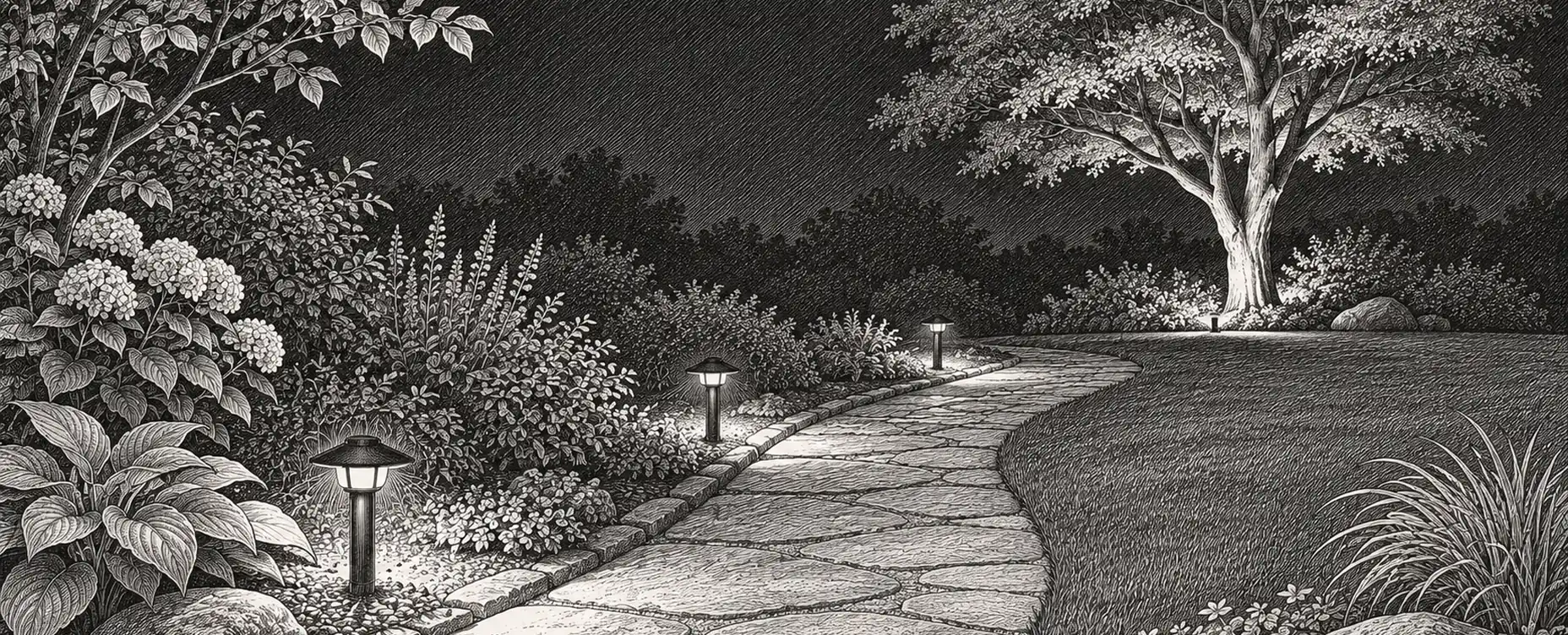
Outdoor lighting is the area where domestic installations most often go wrong in both directions at once: too much light in the places that do not need it, and none at all in the places that do. The result is a garden that is glary rather than lit, a neighbour who is irritated, and a run of steps still in shadow.
Good outdoor lighting is mostly about restraint and layers. Here is how to think about it, and the technical details that decide whether an installation lasts.
Four layers, each doing one job
Almost every good scheme separates these, and almost every poor one tries to do all four with one floodlight.
Wayfinding. Low-level light showing where the path, the steps and the level changes are. This is the safety layer and it needs surprisingly little light — the eye is very good at reading a route from modest, even illumination and very bad at it when a bright source is glaring nearby.
Task. Light where you do something: a barbecue, a workbench, a bin store, a door lock. Brighter, tightly targeted, on when needed.
Ambience. Light that makes the garden pleasant to look at and to sit in — uplighting a tree, grazing a wall, a warm glow on a seating area. Low levels, warm colour, and the layer that most rewards effort.
Security. Responsive rather than constant, which is both better deterrence and better neighbourliness. Covered below.
Working out which layer a fitting belongs to, before buying it, prevents most mistakes.
Less light than you think, warmer than you think
Two numbers determine how an installation feels.
Lumens measure light output. Outdoors, at night, the eye is dark-adapted and needs far less than daytime intuition suggests. A path light of 50 to 100 lumens is often ample; a 2,000-lumen floodlight aimed across a small garden destroys everyone's night vision, including yours, and makes the shadows it creates genuinely darker.
Colour temperature, in kelvin, sets the character. 2,200–2,700 K is a warm, candle-to-incandescent range that flatters planting and looks inviting. 4,000 K and above is cold, commercial, scatters more, causes more glare, and has a greater effect on insects and wildlife. For domestic gardens we would use 2,700 K or below almost everywhere.
Then there is the principle that matters most and costs nothing: you should see the light, not the fitting. Shield sources, aim them away from eye level, tuck them behind planting or under a step nose. A visible bare LED is glare, and glare reads as darkness everywhere else.
Security lighting done properly
The instinct is a bright floodlight burning all night. The evidence and the practicalities both point elsewhere.
Change is the deterrent. A light that comes on as someone approaches signals attention. A light that is always on is simply illumination someone can work by.
Moderate brightness beats maximum. An over-bright light creates a pool of glare and deep black shadow beside it, which is worse for a camera and worse for your own eyes.
Aim down and shield. A floodlight aimed horizontally lights your neighbour's bedroom and the sky. Aimed down at 30 to 45 degrees with a shield, it lights the ground you care about.
Combine with a camera thoughtfully. Many cameras see better in infrared than in a badly aimed white floodlight, and a light directly beside a lens causes flare and attracts insects that trigger motion detection all night. Offset them.
Deal with false triggers. Passive infrared sensors respond to cats, foliage moving in wind and warm air from a vent. Adjust sensitivity, mask part of the sensor, aim across an approach rather than along it, and consider a short hold time so it does not flicker on and off.
The technical specifications that decide longevity
Outdoor fittings fail for boring reasons, and these are the details worth checking.
IP rating. Two digits describing protection against solids and liquids. IP44 handles splashing and is fine under cover. IP65 is protected against jets of water and is the sensible minimum for anything exposed. IP67 adds temporary immersion, needed for in-ground fittings. Anything that will sit in a puddle or be hit by a hose wants IP65 or better, and a fitting sold as “weatherproof” without a number should be treated with suspicion.
Material and corrosion. Stainless steel varies enormously by grade, and cheaper grades rust badly in coastal air. Powder-coated aluminium and solid brass age well; brass in particular weathers to a patina rather than corroding. Plastic fittings become brittle with ultraviolet exposure over a few years.
Gasket and cable entry. Water gets in at joints and glands, not through the housing. A fitting with a proper compression gland lasts; one with a rubber grommet often does not.
Low voltage or mains. A 12 or 24 volt system is safer to install, generally permitted for a competent DIY installation, and easier to extend. Mains outdoor wiring is regulated work in most countries and belongs to a qualified electrician — and in many places any new outdoor circuit requires certification regardless of who fits it.
Replaceable light source. A sealed integrated LED fitting is landfill when the LED or driver fails. Fittings with a replaceable lamp last decades.
Control, and the cold problem
Astronomical scheduling — on at sunset, off at a fixed hour — is better than clock times because it tracks the seasons automatically.
Curfews matter. Ambience lighting off at 11pm is courteous, saves energy, and helps nocturnal wildlife. Wayfinding can stay on at low level, or run on motion after the curfew.
Motion for everything practical. Bins, side gate, shed, steps. On for two minutes at a modest level is almost always better than on all evening.
Scenes rather than switches. One “evening garden” setting that brings up the seating area and the tree uplights, and a separate “working outside” setting that adds task light.
On the technical side, remember that cold affects wireless and batteries. Battery-powered outdoor sensors lose capacity substantially in winter, and lithium cells cope far better than alkaline. Radio range through wet foliage and masonry is also worse than the same distance indoors, which is a real design constraint at the end of a long garden.
Wildlife, which is a genuine consideration
There is now good evidence that artificial light at night affects insects, bats and nocturnal mammals, and that domestic lighting contributes meaningfully in suburban areas.
The mitigations are the same things that make lighting better anyway: warmer colour temperatures, lower levels, shielded fittings aimed down, curfews, and leaving parts of the garden dark. A dark corridor along a boundary hedge is valuable to bats and costs you nothing.
A sensible plan
- Walk the garden at night with a torch and note where you actually need to see: steps, level changes, the bin route, the lock.
- Do wayfinding first, at low level, warm, shielded.
- Add task lighting only where a task happens.
- Then ambience, sparingly — two or three well-aimed uplights outperform a dozen scattered ones.
- Make security lighting responsive, moderate and aimed down.
- Specify IP65 or better, replaceable sources, and low voltage where you can.
- Set a curfew and leave part of the garden dark.
Step one is genuinely worth doing before buying anything. Most people discover they need light in two places and had been planning to install it in six.