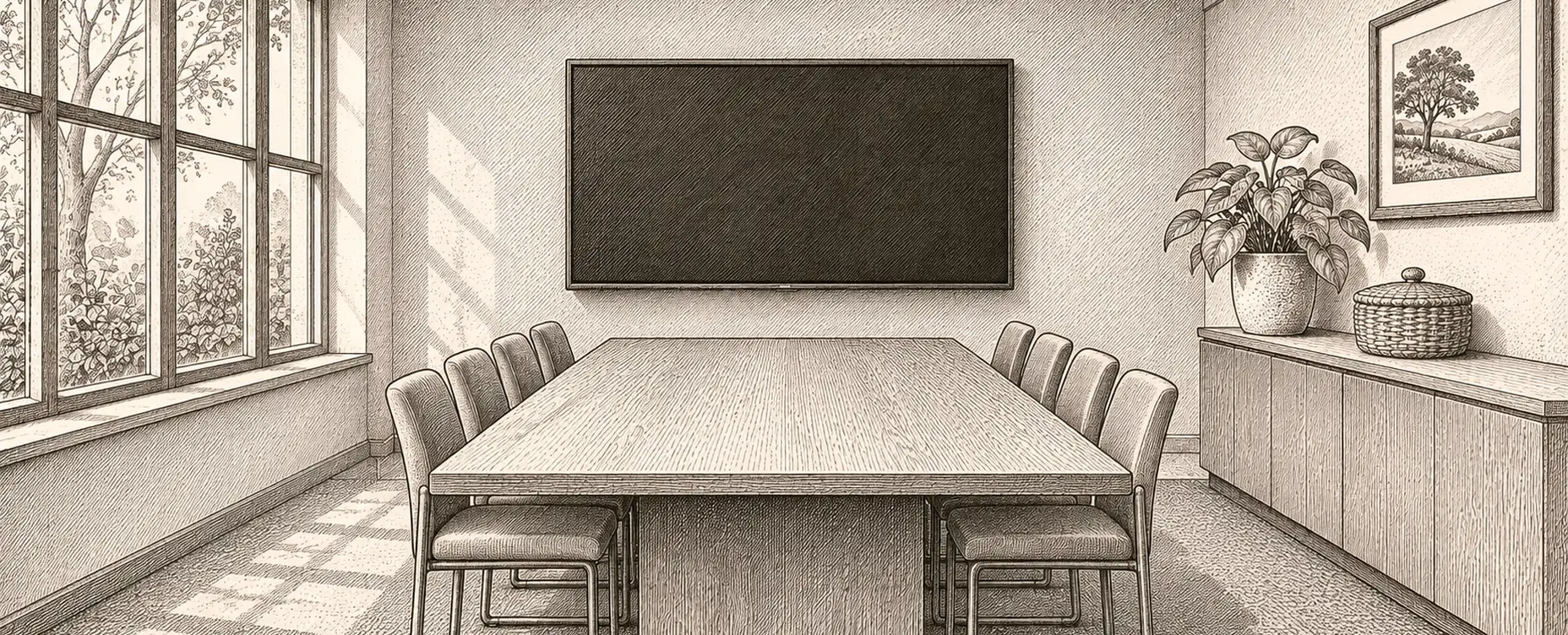
Every organisation with more than three meeting rooms has the same complaint: the rooms are always booked and frequently empty. Someone reserves the large room for a recurring meeting that stopped happening in March. A two-person catch-up occupies the eight-person room because it was the only one free. A booking runs until five although everyone left at half past three.
This is not a technology problem in origin — it is a behaviour problem — but it is one of the few behaviour problems that sensors solve genuinely well, because the fix requires no cooperation from anybody.
What the room needs to know
A meeting room automation needs to answer exactly two questions, and confusing them is the usual cause of failure.
Is the room booked? This comes from the calendar system, not a sensor. Is the room occupied? This comes from a sensor, and no calendar can tell you.
All the useful behaviour lives in the four combinations of those two answers. Booked and occupied is normal. Free and unoccupied is normal. The interesting cases are booked but empty, which is the no-show that wastes the room, and occupied but not booked, which is someone using a free room informally and should generally be left alone.
Choosing the right sensor
Why motion sensors are not enough
A passive infrared sensor detects movement. Six people sitting around a table looking at a screen produce remarkably little of it. Standard PIR sensors commonly decide a meeting room is empty after five to ten minutes of a presentation, which is exactly when you least want the lights to go out.
mmWave presence sensors
Millimetre-wave radar detects the tiny movements of a motionless body — breathing, minor shifts of posture — so it reports a still room as occupied. This is the correct sensor for a meeting room, and it is worth the extra cost over PIR for this application specifically. Mount it on the ceiling near the table rather than by the door, and spend ten minutes tuning the detection zone so it does not see the corridor through a glass wall.
Adding a second signal
For no-show release, one sensor is enough. For anything that acts more aggressively, require agreement: presence plus a rise in carbon dioxide is a very reliable indicator that people are genuinely in the room, because CO2 climbs quickly in a closed room with several occupants and cannot be faked by a curtain moving.
The no-show release
This is the single automation that recovers the most room capacity, and the logic is simple.
- A booking starts.
- Ten minutes in, check the presence sensor.
- If the room is empty, notify the organiser that the booking will be released in five minutes.
- If still empty after that, cancel the booking and mark the room free.
Two details make the difference between this being welcomed and resented. Warn before releasing — a booking cancelled silently while someone is walking from another building generates real anger. And choose the grace period to match your culture: ten minutes is normal in an office where meetings start on time, fifteen is safer where they habitually do not.
What else the room should do
Lighting and blinds
Bring lights to a working level when presence is detected, and drop them to off a few minutes after the room empties. If the room has a projector or large display, a separate presentation scene that dims the lights nearest the screen while keeping the table lit is worth the effort, because the alternative is people turning everything off and taking notes in the dark.
Displays and video conferencing
Wake the display when the room becomes occupied and a booking is active, and switch it off when the room empties. This is a genuine saving as well as a convenience: a large display left on all day in each of six rooms is a meaningful load, and screens are among the biggest standby offenders identified in our shutdown routine.
Ventilation and temperature
Meeting rooms are the worst air quality in most buildings, because they are small, sealed and briefly crowded. Drive ventilation from a CO2 sensor rather than occupancy alone, so the fan responds to how many people are in the room and how long they have been there. We cover the reasoning in more detail in why afternoon meetings feel worse.
The room panel
A small display outside the door showing booked or free, and allowing an on-the-spot booking, removes most of the corridor uncertainty. It is also the most visible part of the system, which means it is what people will judge the whole thing by — so make sure it is accurate before you make it prominent.
Do you need a booking system, or just sensors?
You can get a surprising distance with sensors alone. If every room reports occupied or free to a shared dashboard or door indicator, people stop wandering the building looking for space, and the no-show problem partially solves itself because an empty room is visibly empty.
A full booking integration adds the ability to release reservations automatically, to report utilisation over time, and to answer the question that eventually gets asked in every growing organisation: do we actually need more meeting rooms, or do we need to stop people booking the wrong ones? Utilisation data is the only honest way to answer that, and it is often cheaper than the extra room.
Privacy, and how to stay on the right side of it
Occupancy data is people data, and meeting rooms are places where people have candid conversations. A few principles keep this uncontroversial.
- Count, do not identify. Presence and CO2 sensors report that a room is in use, not who is in it. That is all the automation needs.
- No cameras or microphones in meeting rooms for occupancy purposes. Radar and CO2 do the job without recording anything, and the difference in how staff feel about it is enormous.
- Aggregate the reporting. Room utilisation by hour is useful management information. Which individual sat in which room is surveillance, and in the EU is personal data with all the obligations that follow.
- Tell people. A short note explaining what is measured and why removes almost all suspicion. Discovering a sensor without explanation creates the opposite.
A practical build order
- One room first. Fit a presence sensor and a CO2 sensor in your most-contested room and simply log the data for two weeks. Change no behaviour.
- Compare with the calendar. You now have evidence of how much booked time is unoccupied. This is the number that justifies everything that follows.
- Add lighting and display control in that room, driven by presence. Low risk, immediately appreciated.
- Add ventilation on CO2 if the room has controllable ventilation.
- Add no-show release last, with the warning notification and the exemption category in place from day one.
- Then roll out, and expect each room to need its own sensor tuning. Glass walls and corridors are the usual complication.
Start with the room people argue about most. It is where the evidence is strongest, and where a working system earns the goodwill you will need for the rest of the building.