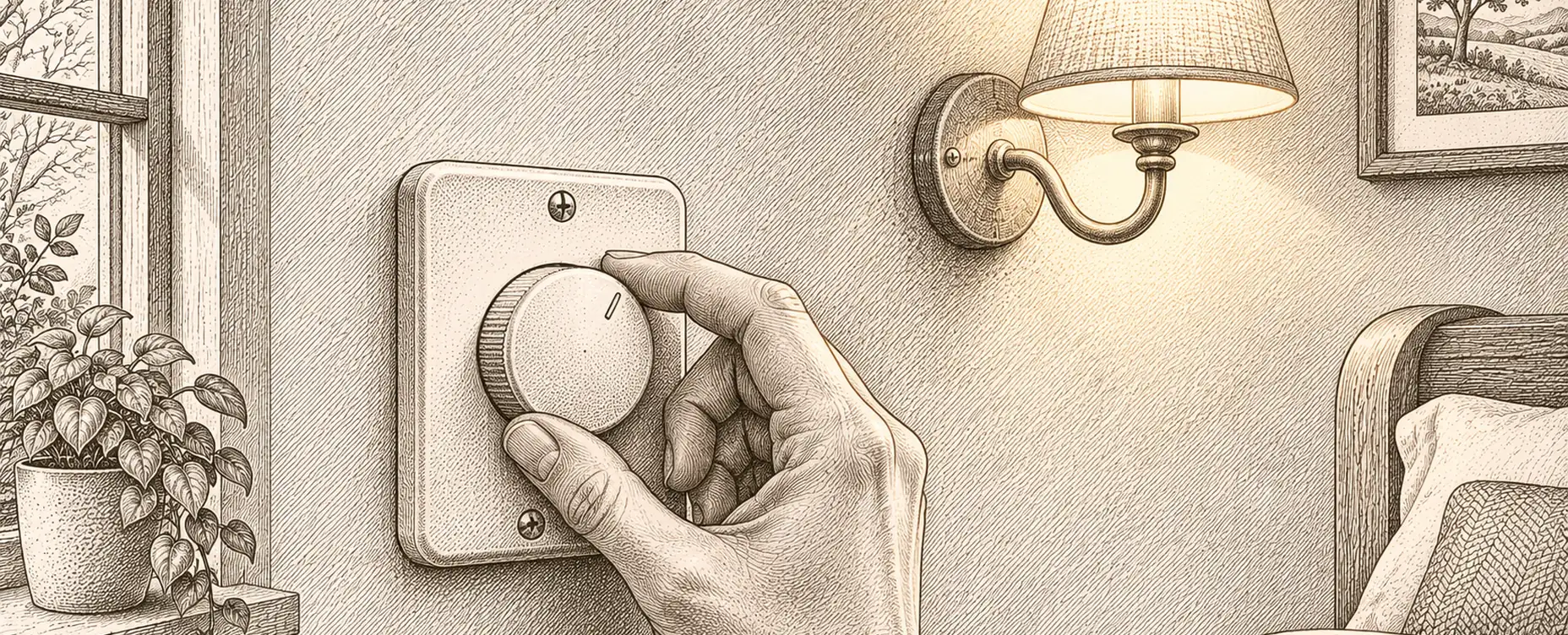
Dimming is where smart lighting most often goes wrong. Bulbs flicker at low levels, buzz audibly, refuse to dim below half, switch off unexpectedly, or work perfectly on one circuit and badly on the next.
Almost all of it comes down to a mismatch between three things that were designed independently: the light source, the dimmer, and the wiring. Here is what is actually happening.
Why LEDs are hard to dim
An incandescent bulb is a resistor. Reduce the voltage and it produces less light, smoothly, all the way down. Dimming it is trivial.
An LED is a semiconductor with a driver in front of it converting mains alternating current into the controlled direct current the LED needs. Reducing the voltage does not gently reduce output — it confuses the driver.
So LED dimming works by manipulating the waveform, and how well it works depends entirely on whether the driver was designed to cope with what the dimmer does to it. Two well-made products can behave badly together simply because they made different assumptions.
Leading edge and trailing edge
This is the distinction that resolves most problems, and it is rarely explained on packaging.
Leading-edge dimmers chop off the beginning of each mains half-cycle. They are the older, cheaper design, built for incandescent and mains-voltage halogen. The abrupt switch-on creates a sharp electrical transient, which is what makes LEDs and their drivers buzz, flicker and behave erratically. If you have an old dimmer switch and new LED bulbs, this is very probably your problem.
Trailing-edge dimmers chop off the end of each half-cycle instead, switching at a gentler point in the waveform. The result is markedly smoother dimming, no audible buzz, and far better LED compatibility.
If you are replacing anything, replace the dimmer with a trailing-edge type rated for LED loads. It is usually a bigger improvement than changing the bulbs.
Minimum load, and why one bulb misbehaves
Many dimmers specify a minimum load — below a certain wattage they do not work reliably.
This was never an issue with incandescent bulbs, where a single lamp drew 60 watts. A modern LED equivalent draws about 7. A dimmer with a 25-watt minimum, driving two LED bulbs totalling 14 watts, is below its operating range — which produces flicker at low levels, a refusal to reach low brightness, or a lamp that glows faintly when off.
Fixes: use a dimmer specified for low LED loads, add more bulbs on the circuit, or fit a load correction device (sometimes called a dummy load or bypass) which presents an artificial extra load. The first is much the tidiest.
The neutral wire problem
A specifically domestic frustration, and the reason many smart switches will not fit in older houses.
Electronics need a continuous supply to keep the radio alive even when the light is off, which means they need both a live and a neutral connection. In many older installations — British wiring in particular — the switch box contains only the switched live and no neutral, because a simple mechanical switch never needed one.
Three ways round it. No-neutral smart switches pass a tiny current through the lamp to power themselves, which works and is the frequent cause of a bulb that glows faintly or flickers when off — a bypass capacitor fitted at the fitting usually cures it. Smart bulbs instead of smart switches, keeping the existing mechanical switch. Or run a neutral, which is proper and means an electrician and possibly a chased wall.
Worth checking what is in your switch box before ordering anything.
Where to put the intelligence
Three architectures, each with a genuine case.
Smart bulbs. Easiest, no wiring, per-bulb colour and dimming. Two drawbacks: they need power at all times, so the wall switch must stay on — which is confusing for guests and infuriating when someone switches it off — and in a fitting with five bulbs you are paying five times.
Smart switches and dimmer modules. The wall switch works normally for everyone, one device controls a whole fitting, and cheap high-CRI bulbs can be used. No per-bulb colour, and it requires wiring work.
Smart drivers or controllers behind the scenes, for LED strip, downlight arrays and low-voltage systems. The most capable and flexible, and the most involved to install.
Our general preference: switches or modules for main room lighting, since keeping the wall switch functional matters more than people expect, and smart bulbs for lamps and accents where you want colour and there is no switch to preserve.
Making dimming feel right
Even with compatible hardware, how you control it matters.
Perceived brightness is not linear. Human vision responds roughly logarithmically, so the step from 5 to 10 per cent looks far bigger than 80 to 85. Good systems apply a curve; if yours does not, expect the bottom of the range to feel coarse and set your scene levels by eye rather than by number.
Fade, do not jump. A transition of half a second to a second feels considerably better than an instant change, and for evening scenes a fade of several seconds is pleasant. Instant changes feel abrupt and cheap.
Find the real minimum. Most systems will not dim to true zero, and below a certain point flicker starts. Establish where that is for your combination and set your lowest scene just above it.
Use scenes rather than percentages. People do not think in numbers. Three or four named levels per room — bright, evening, low, night — are what actually get used.
Diagnosing a problem
A short sequence that identifies most faults.
- Does it flicker only when dimmed? Dimmer and bulb mismatch, or below minimum load.
- Does it buzz? Usually a leading-edge dimmer, or the driver in the bulb. Try a trailing-edge dimmer.
- Does the bulb glow faintly when off? A no-neutral switch, or leakage. Fit a bypass at the fitting.
- Does it work on one circuit and not another? Different dimmers, different load totals, or a two-way switching arrangement.
- Does it refuse to go below half? Minimum load or a driver that does not support deep dimming.
- Did it start after changing bulbs? The bulbs are not dimmable, or not dimmable with that dimmer.
- Is one bulb in a fitting behaving differently? Mixed batches or brands. LED bulbs from different production runs dim differently, and mixing them in one fitting looks visibly wrong.
What we would do
- Check the switch box for a neutral before choosing an approach.
- Use trailing-edge dimmers rated for LED loads, with a low minimum load.
- Buy all the bulbs for one fitting together, same brand and batch.
- Prefer switches or modules for main lighting, smart bulbs for lamps.
- Test one bulb and one dimmer together before buying for the whole house.
- Set scenes by eye, with fades, just above the flicker threshold.
Step five is the one that saves money and irritation. Compatibility between a specific bulb and a specific dimmer is difficult to predict from specifications and trivial to establish by trying it.