Controls a guest can use in the dark, first time, with no instructions
A stranger arrives at eleven at night in an unfamiliar building. Everything has to work first time. It is the opposite of how most people build for themselves.
A stranger arrives at eleven at night in an unfamiliar building. Everything has to work first time. It is the opposite of how most people build for themselves.
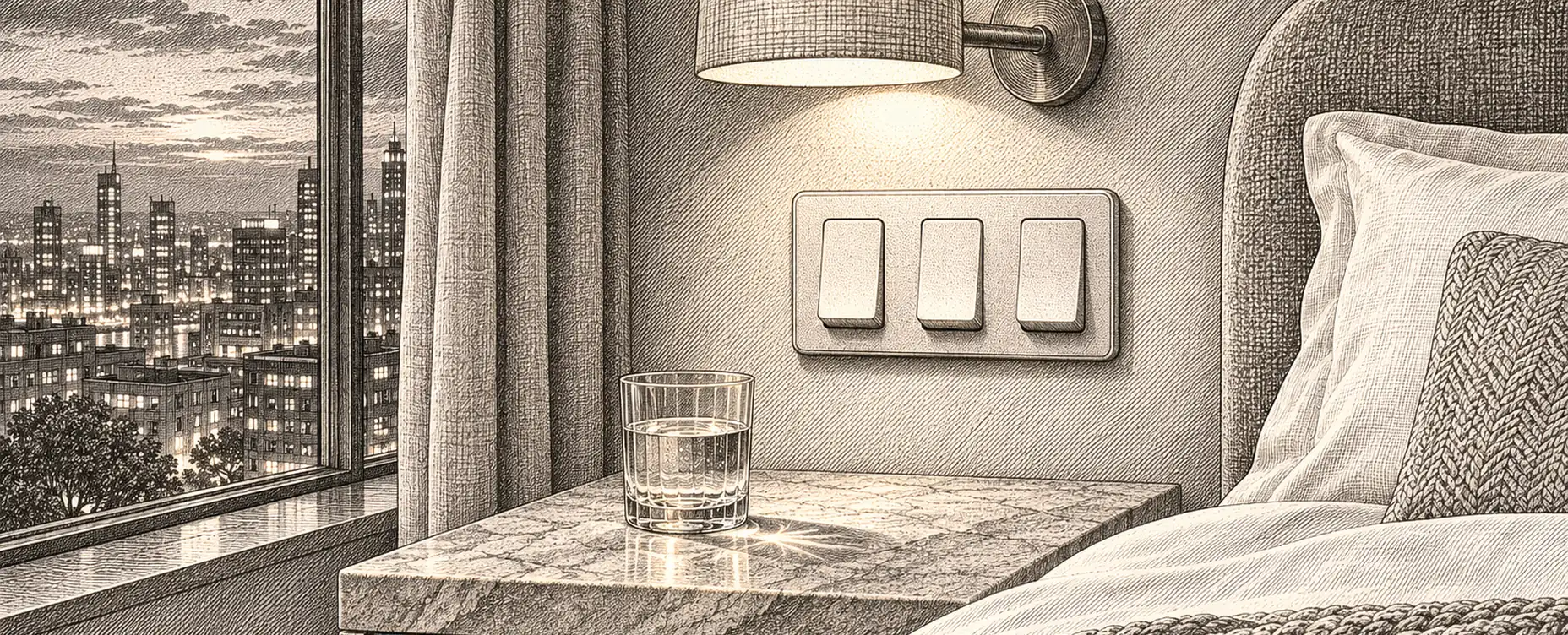
A guest arrives at eleven at night, in the dark, in a building they have never been in, tired, possibly in a country whose language they do not read. Everything in the property has to be operable in that state, first time, without instructions.
That is a genuinely useful design constraint, and it is the opposite of how most people build a smart home for themselves. Complexity you have learned is invisible to you and completely opaque to a guest.
Every control in a guest property should pass that test. It sounds flippant and it is the single most useful filter we know.
Things that fail it: an app the guest must download; a scene controller with unlabelled buttons; a thermostat with menus; a light that only responds to voice; a smart bulb behind a wall switch that must stay on; a lock requiring a phone; a television needing three remotes and an input change.
Things that pass it: a wall switch that switches the light; a dial that gets warmer clockwise; a lock with a keypad; a single obvious remote; a motion-activated night light.
The principle to hold: guest properties want automation behind ordinary controls, not instead of them. Everything can be automated, monitored and optimised — and every control the guest touches should behave exactly as they expect.
Keep every wall switch working. Non-negotiable. A guest who flicks a switch and gets nothing concludes the property is broken, and that appears in a review.
So use smart switches or in-line modules rather than smart bulbs behind a switch that must stay on. This one decision removes the most common source of guest confusion in a connected rental.
Label nothing in jargon, and prefer no labels to clever ones. If a switch needs a label, the layout is wrong.
Automatic night lighting on the route from bedroom to bathroom, at a very low warm level. This is the automation guests notice and mention positively, and it prevents the middle-of-the-night stumble in an unfamiliar layout.
Entrance lighting on arrival, triggered by the door or the lock code, so nobody is feeling along a wall with luggage.
Nothing that changes while they are in the room. Motion timeouts in a living room or bedroom are exactly wrong for a guest sitting still, and a light going off mid-conversation reads as a fault.
A single obvious way to turn everything off at the door on leaving.
The tension is real: a guest with no incentive to save energy will open the window with the heating at maximum, and a guest who cannot adjust the temperature will complain.
The workable answer is a bounded range rather than a locked setting. Let them adjust within, say, 18 to 24 °C and no further. They have control, you have limits, and nobody argues.
Then add the things that stop waste without limiting anyone: window contacts pausing heating in that room while a window is open, a return to a default setpoint at checkout, and a setback when the property is empty between bookings, never off, always a frost minimum.
One practical note on controls: a wall thermostat with a large clear display and up and down buttons is used correctly by guests. A design-led device with a rotating bezel and a hidden menu is not. Choose for legibility.
Bathrooms generate a disproportionate share of both complaints and damage.
Thermostatic mixing valves so stored water can be kept at 60 °C for legionella control while delivering safe temperatures at the tap and shower. This is a safety requirement rather than a nicety in a property let to the public, and it also prevents the scald complaint.
Humidity-triggered extraction, running until the room returns to baseline rather than on a two-minute timer. Guests do not open windows and do not wait, and this is what prevents mould appearing between bookings.
Leak sensors under every sink, behind the toilet, by the shower tray and behind appliances. In a property you do not occupy, a leak runs until someone arrives — and in a flat it runs into the neighbour's ceiling.
A shut-off valve, closed between bookings, which is the single most effective damage prevention available.
A night light in the bathroom at a few per cent, because the alternative is a guest turning on a bright light at 3am.
This is where guest properties get into trouble, and the line is clear.
Legitimate, with disclosure: smoke and carbon monoxide alarms; leak sensors; temperature and humidity; energy and water consumption; noise level in decibels without recording audio; occupancy counts without identification; entry events at the door; outdoor cameras covering the exterior approach.
Never: any camera or microphone inside the property, disclosed or not, and absolutely not concealed. Every major platform bans indoor cameras outright, it is a criminal matter in many jurisdictions, and being caught with one ends a hosting business.
Disclose everything. List every sensor in the property in the listing and in the welcome information, with what it measures. Two reasons: it is required by platform policy and frequently by law, and a guest who reads about a noise sensor before arriving is reassured, whereas a guest who discovers one is alarmed.
The framing that works is worth adopting: we monitor the building, never the guests. A decibel figure, a temperature, a water flow. Nothing that identifies a person or records anything they say.
Beyond safety, a small amount of monitoring genuinely improves running a let.
Departure detection. Knowing the property is empty means cleaning can be dispatched confidently, and a guest who left at 7am gives you five extra hours.
Turnaround verification. Motion in every room after checkout tells you the clean happened and covered the property. A single sensor in a hallway does not.
Consumption anomalies. Water use far above normal is a running toilet or a leak. Electricity far above normal is a window open with heating on, or more people than booked.
Temperature and humidity between bookings, which is how you catch a heating failure in January or a damp problem developing in an empty flat.
Lock code use, which confirms arrival, cleaning and maintenance visits without anybody reporting in.
Sensor health. A battery sensor that died three weeks ago is a hole in your protection you do not know about, and in an unoccupied property nobody will notice. A weekly report on every device that has not reported is the least glamorous and most valuable automation in a rental.
Item one prevents most guest confusion, item six prevents most expensive damage, and item nine is what keeps the other eight actually working.