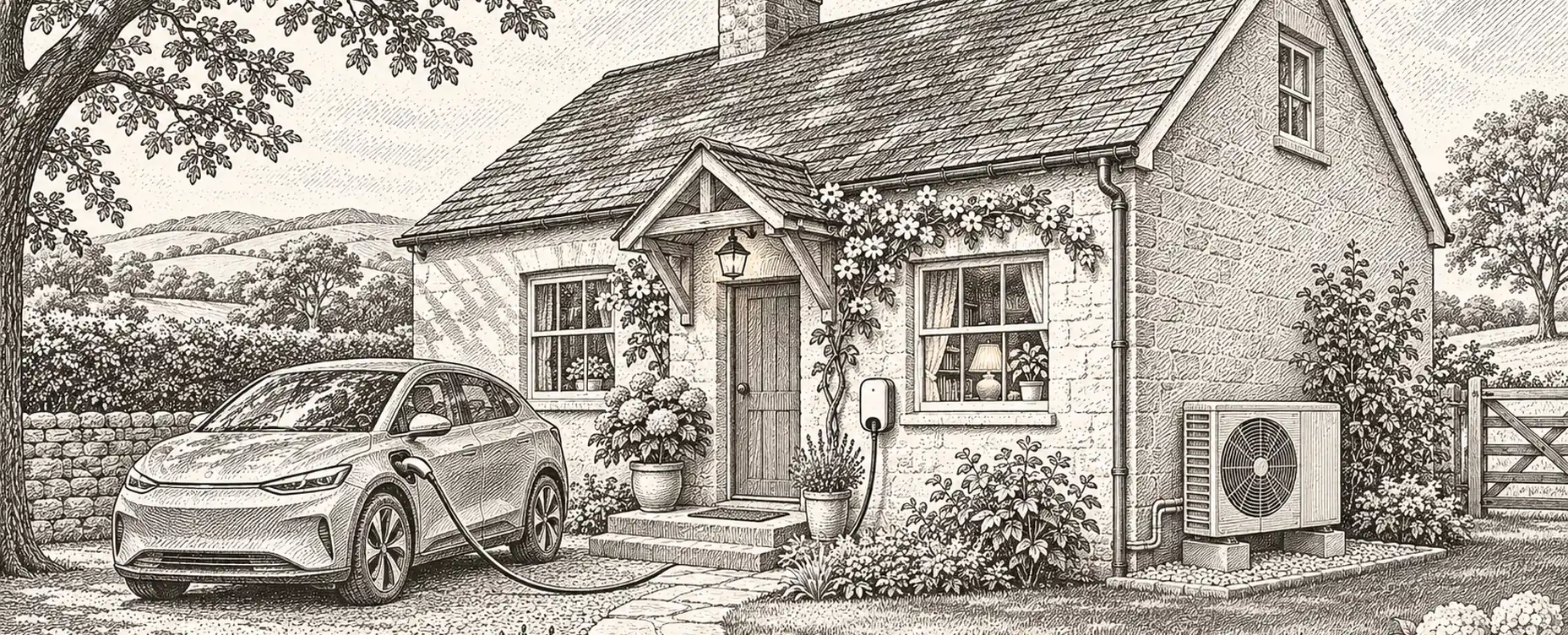
Electrifying a home — swapping a gas boiler for a heat pump, a petrol car for an electric one — changes your energy bills in a way that catches people out. Total energy costs frequently fall. The electricity bill roughly doubles or worse, because loads that used to appear on a gas bill or at a petrol station now arrive on one meter.
That shift has practical consequences beyond the bill, and they are worth understanding before rather than after.
Your electricity consumption changes shape, not just size
A typical household before electrification uses perhaps 2,500 to 4,000 kilowatt-hours a year, in a fairly flat profile with an evening peak.
Add a heat pump and you add a large seasonal load concentrated in winter, running for many hours a day at moderate power. Add an electric car and you add a large load that is entirely flexible in timing and quite inflexible in total.
Three things follow.
Your annual consumption may triple. That changes which tariff suits you, and it makes the unit rate matter far more than the standing charge.
Your peak demand rises. A heat pump and a car charger running together, plus cooking, can approach or exceed the capacity of an older domestic supply.
Timing becomes valuable. Where before you had little to shift, now you have a great deal — which is what makes time-varying tariffs worth having.
Supply capacity: the constraint nobody mentions
This is the practical problem that stops projects, and it is worth checking early.
Your property has a maximum supply capacity, determined by the main fuse and the connection. In many older homes that is lower than people assume. A heat pump drawing perhaps 3 kW, a car charger at 7 kW, an electric shower at 9 kW and an oven and hob together can exceed it comfortably.
There are three responses, in increasing order of cost.
Load management. A controller that shares available capacity between large loads, throttling the car charger when the shower is running. Cheapest, effective, and it is what most installations should do regardless.
Sequencing. Simply not running the big loads simultaneously, which automation handles invisibly.
A supply upgrade. An application to your network operator, potentially involving work in the street. Expensive, slow, and occasionally refused or delayed in constrained areas.
Heat pumps: what actually changes
A heat pump moves heat rather than generating it, delivering several units of heat per unit of electricity — that ratio is the coefficient of performance, and it varies with outdoor temperature, falling on the coldest days when you need heat most.
Two operational differences matter for automation.
They prefer long, steady, low-temperature running. A gas boiler is happy blasting to temperature and stopping. A heat pump is most efficient running continuously at a low flow temperature. This inverts a lot of received wisdom: deep setbacks and rapid reheating, which suit a boiler, actively harm heat pump efficiency.
They respond slowly. Which makes scheduling more important and reactive control less useful. Pre-heating on cheap electricity works well; expecting a fast recovery from a cold house does not.
The practical implication is that a thermostat designed for on/off boiler control can measurably worsen a heat pump's performance. Look for controls that understand weather compensation and modulation, and be wary of applying boiler-era schedules to heat pump hardware.
Electric cars: the biggest and easiest load
Charging is typically the single largest addition to a household's electricity consumption, and also the most flexible — which makes it the easiest large saving available.
Charge overnight on a cheap rate. The one thing that matters. Even a simple time-of-use tariff with a timer captures most of the benefit.
Use load balancing so the charger reduces its draw when the house is busy, rather than tripping the main fuse.
Do not over-specify. A 22 kW charger needs a three-phase supply and most cars cannot accept more than 11 kW of alternating current anyway. At 7 kW on single phase, an overnight charge adds well over 50 kWh, which is more than most people drive in several days.
Solar surplus charging is satisfying and only useful when the car is home in daylight. For most commuters that means weekends.
Monitoring becomes genuinely necessary
Before electrification, energy monitoring is interesting. After, it is close to essential, because you now have several large loads on one meter and no way to attribute consumption without measurement.
What you want: whole-house consumption, plus separate metering for the heat pump and the charger. That lets you see the heat pump's real performance across a winter, catch it running inefficiently, and know what the car actually costs per charge. Circuit-level clamps in the consumer unit are the usual answer, and they go in during installation far more cheaply than afterwards.
It also lets you answer the question everybody asks after their first winter with a heat pump, which is whether it is performing as promised. Without measurement that is a matter of opinion; with it, it is a number you can take to the installer.
Automation earns its keep here
An electrified house has more moving parts than a gas-heated one, and coordination between them is where the remaining savings live.
Sequencing large loads. Charging the car and heating hot water and pre-warming the house all want the cheap overnight window. Doing them simultaneously may exceed your supply; doing them in sequence within the same window costs nothing extra and avoids the problem entirely.
Price-aware heating. A heat pump with a well-insulated house can be nudged warmer during cheap hours and allowed to drift during expensive ones — a shallow drift of a degree, not a deep setback. The building fabric does the storing.
Diverting surplus. On a sunny day with the car away, surplus generation has somewhere useful to go: hot water, or pre-conditioning the house before an evening price peak.
None of this needs to be clever. It needs to be reliable, which usually means a hub that holds the logic locally and keeps running when a cloud service or your internet connection does not — because a house whose heating depends on someone else’s server is a house with a new failure mode.
A sensible order of operations
- Insulation and draughts first. Unglamorous, and it reduces the size of heat pump you need, which reduces both capital cost and running cost. A heat pump sized for an uninsulated house is an expensive mistake.
- Establish supply capacity and plan load management before ordering anything.
- Get a time-varying tariff, which costs nothing and makes everything else cheaper.
- Car first if you are getting both, because it is the simpler installation, the larger flexible load, and it teaches you how tariff shifting works.
- Then the heat pump, with controls chosen for modulation rather than on/off, and with circuit metering fitted at installation.
- Then consider solar and storage, sized against your new and much larger consumption rather than your old one.
Step one is the one most often skipped and the one with the best return, and step six is the one people want to do first. Doing them in this order results in a smaller, cheaper, better-performing system than doing them in the order of enthusiasm.