Humidifiers and dehumidifiers: which, when, and usually neither
Humidifiers and dehumidifiers are bought reflexively, often for the wrong problem. Deciding correctly takes a cheap sensor and two weeks.
Humidifiers and dehumidifiers are bought reflexively, often for the wrong problem. Deciding correctly takes a cheap sensor and two weeks.
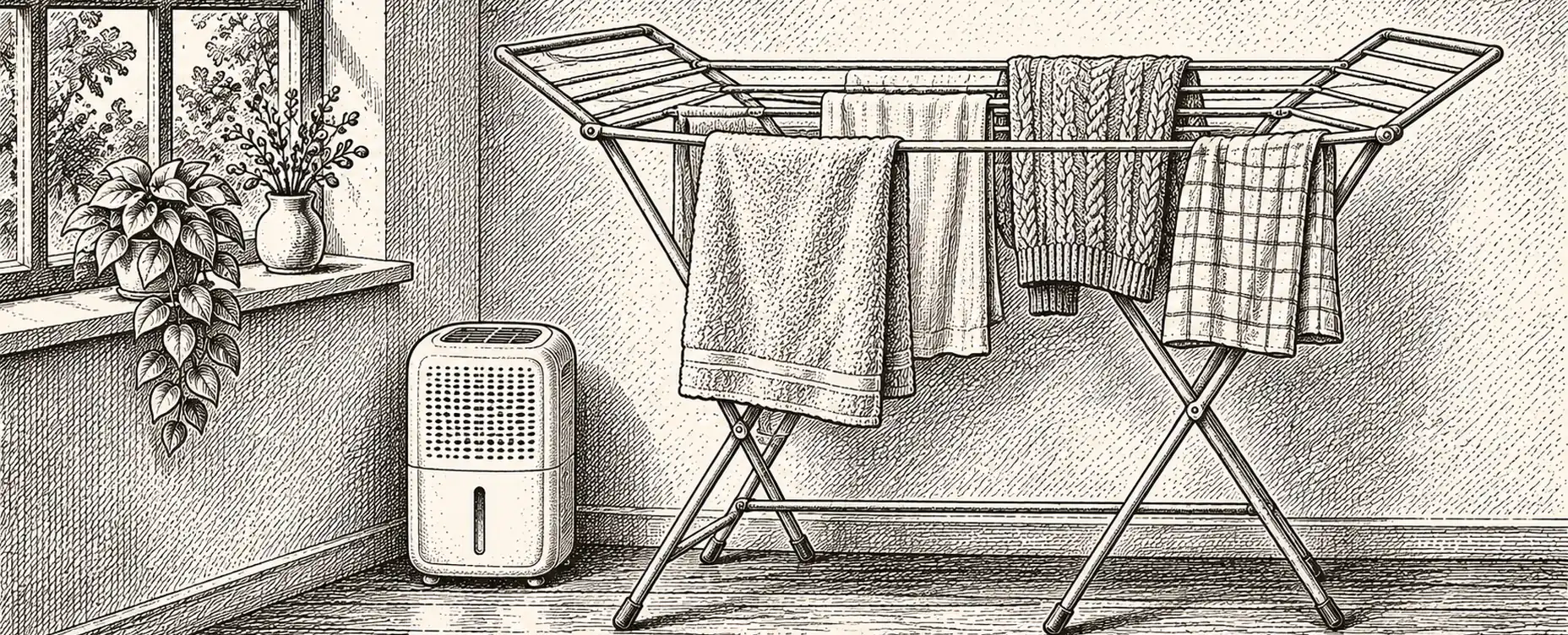
Humidifiers and dehumidifiers are bought reflexively, often for the wrong problem, and occasionally in the same house in the same season. Both are useful in specific circumstances and both are frequently the wrong answer to a problem that ventilation or heating would solve better.
Deciding correctly takes a cheap sensor and two weeks.
Dry air and damp air both cause discomfort, and the sensations overlap enough that people guess wrong.
The target band is roughly 40 to 60 per cent relative humidity. Below about 35 per cent is dry; sustained above about 65 is damp and mould-prone.
So measure, in the rooms that concern you, for a fortnight before buying anything. Cheap sensors are entirely adequate, and the results frequently surprise people — a house that feels dry in winter often is, and a bathroom that feels fine may be sitting at 75 per cent for hours after every shower.
Note that humidity varies enormously through a day and between rooms, so a single spot reading tells you little. It is the pattern you want.
Dehumidifiers remove water from air, and they work. The question is whether removing it is the right response.
Where a dehumidifier is the right answer:
Drying out after a leak or a flood, where you need to remove a large quantity of water quickly. This is the clearest case.
Drying laundry indoors, in a closed room. A dehumidifier plus a fan in a small room is surprisingly efficient at this and considerably better than a rack in the living room.
A basement, cellar or garage with no practical ventilation and no heating.
A specific stubborn room where you have already fixed the causes and it still runs damp.
Where it is the wrong answer:
Anywhere the real cause is indoor laundry drying, an unvented dryer, a blocked trickle vent or a bathroom fan that runs for two minutes. Fix the cause; a dehumidifier running permanently to compensate is expensive.
Anywhere the real cause is a cold surface. Mould in the corner of an unheated spare room is a temperature problem, and a small amount of background heat often cures it where a dehumidifier will not.
Anywhere the real cause is rising or penetrating damp or a plumbing leak. A dehumidifier will run forever against a source that never stops.
Two technologies, and the choice depends on temperature.
Refrigerant dehumidifiers cool a surface below the dew point so moisture condenses onto it. Efficient in warm conditions and their performance falls off markedly as the room gets colder — below about 15 °C many struggle, and below 10 they may barely work or need to defrost repeatedly.
Desiccant dehumidifiers pass air over a moisture-absorbing material which is then regenerated with heat. They work well at low temperatures, which makes them the right choice for an unheated garage, cellar or conservatory. They use more electricity for the same water removed in warm conditions, and they emit useful heat, which is a bonus in a cold space and a nuisance in summer.
Practical rule: heated living space, refrigerant; cold unheated space, desiccant.
On capacity, the rated litres per day is measured under generous test conditions, typically warm and very humid, and real-world extraction is lower. Size generously rather than exactly.
Winter dryness is real. Cold outdoor air holds little moisture, and heating it without adding water produces low relative humidity indoors — commonly 25 or 30 per cent in a well-heated house in a cold climate.
That causes dry eyes, irritated airways, static, and can aggravate asthma and eczema. It also dries out wooden instruments and furniture, which is a genuine reason people humidify.
Before buying one, note that lowering the temperature a degree raises relative humidity, and that ordinary household activity adds moisture. If your readings are in the 35 to 40 range, a humidifier is probably unnecessary.
Types, briefly. Evaporative units pass air through a wet wick and are self-limiting, which is a safety feature — they cannot easily over-humidify. Ultrasonic units are quiet and produce a fine mist, and they disperse whatever is in the water, which is why they leave white dust with hard water and why hygiene matters. Steam units boil water, which is hygienic and uses considerably more electricity, and presents a scald risk with children.
This is where a smart home genuinely improves matters, because both devices should respond to a measurement rather than run continuously.
Control from a room sensor, not the unit's own. A dehumidifier measures the air it is drawing in, which is the most humid air in the room. An independent sensor at head height across the room gives a better reading and better control.
Use a deadband. Switch on above 62 per cent, off below 55, rather than at a single threshold — otherwise the unit cycles constantly, which is inefficient and noisy.
Ventilate first where possible. If outdoor absolute humidity is lower than indoor, opening a window is free and a dehumidifier is not. An automation that checks this before switching on is the genuinely intelligent version.
Run on cheap electricity where the timing does not matter, which for a cellar it usually does not.
Alert on the tank being full or, better, plumb the drain so it never fills.
Alert on failure to reach target, which means the unit is undersized, the room is unsealed, or there is a source you have not found.
Stop a humidifier at 55 per cent, firmly, and never let it push a room higher.
Log the water removed. A dehumidifier extracting the same amount every day for months is telling you there is a source, not a humidity level.
Step two is where most of the wins are. A dehumidifier bought to compensate for drying washing indoors costs money every day to solve a problem that a clothes line solves for nothing.