Why your house has a cold room, and how to find out which cause
Every house has one. The cause is usually identifiable in an afternoon with about twenty pounds of sensors — and it is rarely the boiler.
Every house has one. The cause is usually identifiable in an afternoon with about twenty pounds of sensors — and it is rarely the boiler.
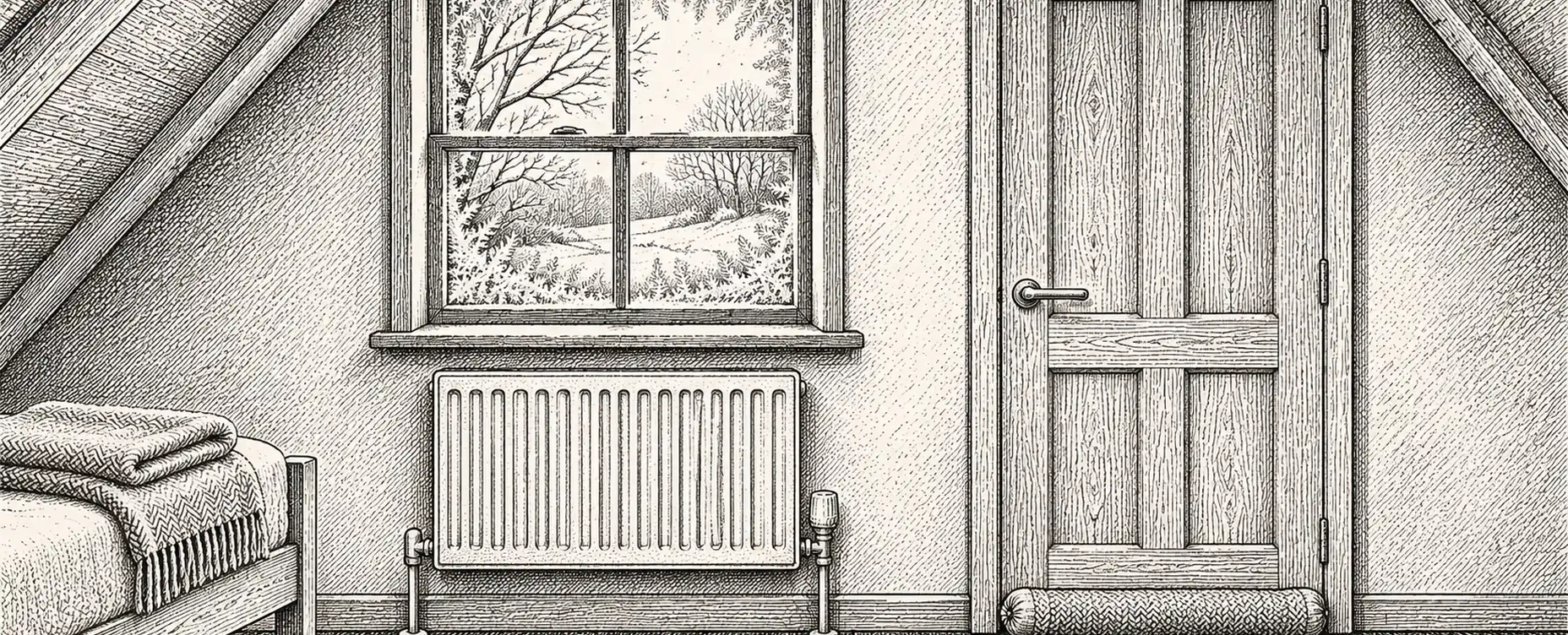
Almost every house has one. The room that never warms up, the bedroom that is stifling, the extension that is cold whatever the thermostat says. Households live with these for decades, and the cause is usually identifiable in an afternoon with about twenty pounds of sensors.
Here is a diagnostic sequence, from the cheapest and most likely cause to the most expensive, so you spend money on the actual problem rather than the assumed one.
Put a temperature and humidity sensor in every room and leave them for a fortnight, ideally in cold weather. Then look at the pattern rather than the moment.
What you are looking for: how cold is it really compared with your impression, when is it coldest, and how fast does it warm and cool relative to other rooms. Those three facts distinguish most causes.
Also worth knowing: air temperature is not the whole story. Radiant temperature — the temperature of the surfaces around you — affects comfort roughly as much. A room at 21 °C with a large single-glazed window and cold walls feels distinctly colder than a room at 19 °C with warm surfaces, because you radiate heat towards cold surfaces. This is why a conservatory or a room with a big cold window never feels right at a temperature that suits elsewhere, and why an infrared thermometer pointed at walls and glass is a genuinely useful diagnostic.
The most common cause and the cheapest to fix.
Feel the radiator when heating is running. Cold at the top, warm at the bottom means air trapped inside — bleed it. Cold at the far end horizontally, or cold at the bottom with a warm top, suggests sludge and debris settled inside, which needs flushing.
Cool all over while other radiators are hot means it is not getting its share of flow. This is a balancing problem: water takes the path of least resistance, so radiators near the boiler get plenty and distant ones get little. Adjusting the lockshield valve — the plain one under a cap, opposite the adjustable valve — to restrict the greedy radiators forces flow to the starved ones. It is free, takes an hour with two thermometers, and it fixes a remarkable number of cold rooms that people were about to solve with a new boiler.
Stone cold with the valve open may be a seized valve pin, common on old thermostatic valves left in one position for years. Removing the head and pressing the pin often frees it.
Radiators are sized for a room's heat loss, and rooms change. An extension, a converted garage, a knocked-through wall, a room with new large glazing, or simply an original undersizing all leave a radiator unable to keep up.
The tell from your data: the room warms very slowly and never quite reaches target on cold days, while the radiator itself is properly hot throughout. That combination points at capacity rather than flow.
This matters far more on a heat pump, because at lower flow temperatures every radiator emits less. A radiator that was adequate at 70 °C may be badly undersized at 45 °C, which is why heat pump installations so often involve upsizing emitters. If you are considering a heat pump, an undersized radiator is a design issue to raise before installation, not after.
Now we are into building fabric, and the data gives a clear signature: the room cools much faster than others once heating stops.
Usual suspects, cheapest first. Draughts — around floorboards, skirtings, loft hatches, old sash windows, unused chimneys, and the gap where a pipe or cable passes through a wall. Draughtproofing is the best value per pound in the entire house. An uninsulated bay window or a floor over an unheated space such as a garage or a void, which is a frequent cause of a cold room over a garage. A solid external wall, or a cavity that was never filled or has failed. Missing loft insulation above that specific room, which happens surprisingly often around hatches, eaves and where a bathroom fan was fitted.
An infrared thermometer or a thermal camera makes this obvious, and thermal imaging works best on a cold day with the heating on, viewed from inside.
A single thermostat controls the whole house from one point, so its position sets everything else.
If it is in a warm room, the rest of the house is cold. If it is in a cold hallway, the rest overheats. If it is above a radiator or in the sun, it is reporting fiction.
The fix is either to move it to an internal wall at about 1.5 m in the room you most want comfortable, or to use a remote sensor placed properly — which is one of the better arguments for a smart control, since you can put the sensor where it should be regardless of where the wiring is.
Some cold rooms are caused by things in the room.
Furniture in front of the radiator, a sofa or a bed against it, or a shelf directly above — all trap the convection current the radiator relies on. A long curtain hanging over a radiator sends its output straight up the window and out through the glass, which is worse than it sounds.
An extractor fan or an open trickle vent pulling cold air continuously into a room that already struggles.
A hidden opening: a cat flap, an unsealed old vent, a defunct extract duct.
A cold surface causing a draught. Cold glass creates a downdraught of chilled air that pools at floor level and feels like a leak even when the window is perfectly sealed. This is why radiators were traditionally placed under windows, and why moving one away from a window can make a room feel worse.
Overheating rooms have their own causes, and they are worth naming because the fix is different.
A radiator on the same circuit with no independent control, so the bedroom is heated whenever the living room asks for heat. A smart radiator valve solves this directly and it is the classic case for one.
Rising heat, since a top-floor room receives what everything below sheds. Sometimes a bedroom simply needs no heating at all.
Solar gain through a west-facing or roof window, which is a shading problem rather than a heating one.
A hot water cylinder or uninsulated pipework in a cupboard, quietly heating the room around it. Insulating the cylinder and its pipes is cheap and effective.
Steps one to four cost almost nothing between them and resolve the majority of cold rooms. The reason we labour this is that cold rooms are routinely used to justify a new boiler, and a new boiler does not fix a balancing problem, a draught or a radiator behind a sofa.