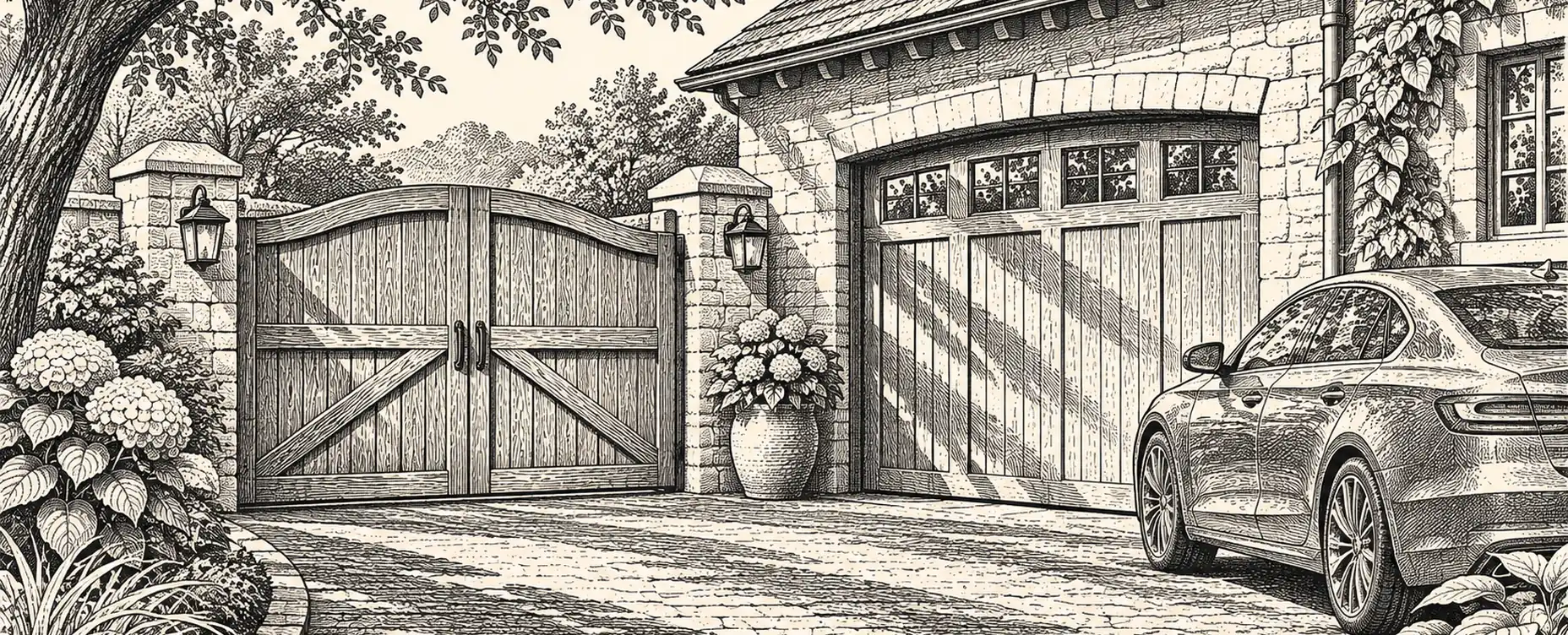
Garage doors and driveway gates are the largest moving objects in a domestic setting, and they are frequently the weakest point in a home's security. Both are worth automating, and both carry genuine safety obligations that consumer marketing tends to skip.
We will take the safety part first, because it is the part where getting it wrong hurts someone.
The safety requirements, which are not optional
Powered doors and gates have crushed and killed people, including children, and that history is why the regulations exist. In the European Union, a powered gate or garage door installation is generally treated as machinery, requiring a risk assessment, appropriate safety devices, and documentation. Similar frameworks apply elsewhere.
The protections that matter:
Force limitation. The drive must detect an obstruction and stop or reverse, with limits on the force applied. This is built into good drives and adjustable — and adjusting it up to overcome a stiff door is exactly the wrong response to a mechanical problem.
Photocells. An infrared beam across the opening that stops or reverses the door if broken. Mandatory in practice for automatic closing, and the single most important device on the installation. A garage door that closes on a timer without a working photocell is dangerous, and this is not a theoretical concern — children and pets are exactly the height involved.
Safety edges on gates, which detect contact along the leading edge.
Crush and shear point protection. Sliding gates in particular create trap points against posts and fences, which need physical guarding or adequate clearance.
Manual release. You must be able to open the door by hand if power fails, and everyone in the household should know how — including how to reach a release cord if the only entrance is the garage door itself.
Why garage doors are a security weak point
Three reasons, all worth addressing.
Old remote controls are trivially defeated. Openers made before roughly the mid-1990s often used fixed codes, which can be captured and replayed, and some used a small set of dip-switch codes that can be cycled through in minutes. If your opener predates rolling code technology — where the code changes on every press — the remote is not meaningfully secure.
The manual release can be reached from outside. On many up-and-over and sectional doors, a coat hanger through the top gap can hook the emergency release cord. A commercially available shield, or simply removing an over-long cord and repositioning the release, closes this.
The internal door is often poor. Once inside a garage, the door into the house is frequently a lightweight internal door with a weak lock, and it is out of sight from the street. That door deserves the same cylinder and frame treatment as your front door, and a contact sensor.
Add to that the fact that garages hold tools, bicycles and increasingly EV chargers, and it is worth more attention than it usually gets.
What to add, and in what order
1. Position sensing. Knowing whether the door is open or closed is the highest-value addition, because the commonest real problem is a garage door left open all night. A tilt sensor on the door panel or a contact at the closed position answers it.
2. Photocells, if absent. Before any remote closing.
3. Alerting. Open after dark, open when the house is in away mode, open for longer than an hour. This is where most of the practical benefit lives.
4. Remote control. Useful, and only safe with the items above in place.
5. A camera covering the opening, so remote closing is not blind.
6. Rolling code upgrade, if your opener is old. Often a new receiver and remotes rather than a whole opener.
7. Contact sensor and better lock on the internal door.
Integration, and the walled garden problem
Garage door openers are one of the categories where manufacturers have been most inclined to close their systems, and where they have withdrawn or paywalled integrations that used to work.
Two approaches. The manufacturer's own connectivity, which is simple and dependent on their platform continuing to exist and continuing to allow third-party access. Or a generic relay and sensor module that wires into the opener's manual push-button terminals and reports position from your own sensor. That works with almost any opener, is entirely local, and cannot be withdrawn by anyone.
We would lean towards the second, particularly given how many people have been on the wrong end of an integration being switched off. The wiring is low voltage and simple, and it puts the control in your own system.
One important detail: most openers respond to a momentary contact that toggles — open, stop, close, stop. That means a naive “press the button” automation does not know what the door will do. Always pair a relay with a position sensor and check state before acting, or you will eventually stop a door halfway and leave it there.
Gates, which add their own problems
Power at the gate is the first hurdle. Options are a buried mains supply, which is proper and involves a trench, or solar with a battery, which suits low-traffic gates and struggles with heavy use in winter.
Radio range to a gate at the end of a drive is often marginal. Sub-gigahertz protocols reach further than 2.4 GHz, and a mains-powered relay partway helps. Where a cable can be run, run it.
Access for visitors and deliveries. An intercom, a keypad, or a video entry panel. Consider what happens when the internet is down — a delivery driver at a gate that cannot open is a returned parcel.
Emergency services access is a serious consideration and sometimes a legal one. A gate that cannot be opened without power or a code may delay an ambulance or a fire crew. Provide a documented manual release, and check whether your local services use a standard key or box arrangement.
Vehicle detection. Ground loops, radar or magnetic sensors let a gate open automatically for a vehicle leaving and, more importantly, prevent it closing on one.
Automations worth building
Close at night if open, with the photocell active and a notification. The rule that prevents the commonest problem.
Close when everyone leaves, after a delay and a check.
Notify if open longer than an hour, which catches the forgotten door.
Light the garage on opening, with a generous timeout, since garages are exactly where motion timeouts fail while you are bent over a workbench.
Open on arrival, if you want it — but require a positive local signal rather than a geofence, or you will find the door opening while you drive past.
Alert on opening while away, treated as a security event.
Frost or freeze awareness if pipework or an EV charger sits in the garage.
Stop closing if a vehicle or person is detected, which is the photocell's job and worth verifying works rather than assuming.
A sensible plan
- Check your opener's age and whether it uses rolling codes.
- Check for working photocells, and fit them if absent.
- Shield or reposition the emergency release so it cannot be hooked from outside.
- Add position sensing and the open-at-night alert.
- Upgrade the internal door lock and add a contact sensor.
- Use a local relay and sensor rather than depending on a manufacturer cloud.
- Add a camera before enabling remote closing.
- Have powered gates safety-tested and keep the documentation.
Items two and three cost very little and are the two we would not skip — one is about somebody getting hurt, the other about somebody getting in.