Best Buys › Smart Plugs
Smart Plugs
The cheapest useful smart device in the house — provided you check the amp rating before plugging in a washing machine.
Best Buys › Smart Plugs
The cheapest useful smart device in the house — provided you check the amp rating before plugging in a washing machine.
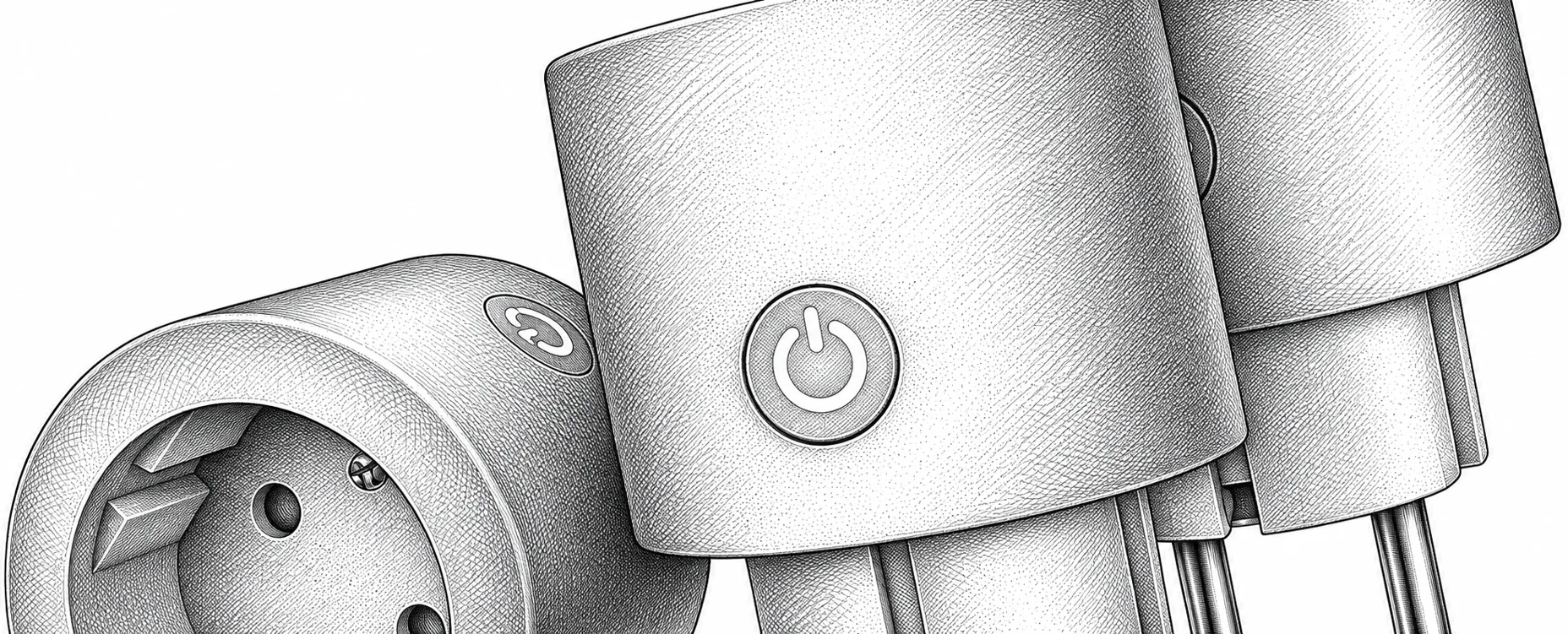
A smart plug does two jobs: it switches whatever is plugged into it, and on most models it measures how much electricity that thing uses. The second job is the more valuable one. A metering plug rotated around the house for a fortnight will tell you exactly which appliances are quietly costing you money, and it is the trigger behind the most popular automation people build — a notification when the washing machine finishes, detected from the drop in power draw rather than a timer.
The specification that actually matters is the maximum load, and it is where most buying mistakes happen. A 10 A plug handles roughly 2300 W and is fine for lamps, TVs and chargers. Washing machines, dryers, dishwashers, kettles and heaters need a 16 A plug rated around 3680 W. Worse, motor-driven appliances draw a large surge at switch-on — an inductive load — which can exceed the plug’s rating even when its running consumption looks safe. At least one popular 16 A plug explicitly states it is unsuitable for inductive loads.
As with bulbs, mains-powered Zigbee, Z-Wave and Thread plugs act as routers that relay traffic for your battery sensors. Because plugs are permanently powered and scattered around the house, they are the single most effective way to strengthen a mesh network.
10 A (about 2300 W) suits lamps and electronics. 16 A (about 3680 W) is needed for washing machines, dryers, dishwashers, kettles and any heater. Check the appliance’s rating plate, not its typical consumption.
Anything with a motor or compressor — washing machines, pumps, fridges, power tools — draws a brief but very high inrush current at switch-on. Some plugs specifically warn against these even at 16 A. Never put a fridge or freezer on a smart plug you might switch off by accident.
Most plugs now include it; a few premium ones still do not. If you want per-appliance consumption data or finished-cycle detection, confirm it is present rather than assuming.
A bulky plug blocks the adjacent socket on a double outlet, which halves the usefulness of the wall. Round bodies around 45 mm are the safe choice; check depth too if the socket sits behind furniture.
Overload, overheat and overcurrent cut-offs, plus a flame-retardant housing, are worth having on anything that will run a high-draw appliance unattended.
Configurable power-on state decides whether the plug returns on, off, or to its last state. For a dehumidifier you want on; for a heater you almost certainly want off.
| Brand | Model | Protocol | Max load | Metering | Mesh router | Indicative price |
|---|---|---|---|---|---|---|
| IKEA | GRILLPLATS | Matter over Thread | 16 A / 3680 W | Yes | Yes | €10 |
| ThirdReality | Smart Plug E2 | Zigbee | 16 A / 3680 W | Yes | Yes | €14 |
| Shelly | Plug S MTR Gen3 | Matter over Wi-Fi | 12 A / 2500 W | Yes | No | €24 |
| TP-Link | Tapo P110M | Matter over Wi-Fi | 16 A / 3680 W | Yes | No | €25 |
| frient | Smart Plug Mini 2 | Zigbee | 16 A / 3840 W | Yes | Yes | €39 |
| Innr | SP 240 | Zigbee | 16 A / 3680 W | Yes | Yes | €25 |
| Eve | Energy | Matter over Thread | 11 A / 2500 W | Yes | Yes | €40 |
| Aqara | SP-EUC01 | Zigbee | 10 A / 2300 W | Yes | Yes | €30 |
| Fibaro | Wall Plug | Z-Wave | 11 A / 2500 W | Yes | Yes | €60 |
| POPP | Outdoor Plug | Z-Wave | 16 A / 3500 W | Yes | Yes | €55 |
| Philips Hue | Smart Plug | Zigbee | 10 A / 2300 W | No | Yes | €35 |
Prices move constantly and vary by country, so we give an indicative band rather than a figure that would be stale within a month. Check the brand's own store for the current price.
On paper this should not exist: a 16 A metering plug with native Matter over Thread for about a tenner. It replaces IKEA’s older Zigbee plugs and, because it is mains powered, it acts as a Thread router — so buying five of them meaningfully improves the mesh your battery sensors depend on.
If you are starting from scratch and want plugs everywhere, this is the value pick by a wide margin. Buy the 16 A rating you need and spend the savings on sensors.
ThirdReality builds plain, well-behaved Zigbee hardware at low prices, and the E2 is the obvious pick if your network is Zigbee rather than Thread. Metering, overload protection and a configurable state after a power cut, in a body small enough not to block the next socket.
Read the caveat carefully though: despite the 16 A headline, the manufacturer says it is not for inductive loads. That rules out the washing machine and dryer, which are precisely the appliances people most want to monitor. Use frient, Innr or Tapo for those.
Shelly’s Gen3 plug is the tidiest Wi-Fi option: small, well-protected electrically, and Matter-certified so it needs no Shelly cloud account. The LED ring showing load is genuinely useful, and it dims at night rather than glowing at you in a bedroom.
Two limits. At 12 A it is a lamp-and-electronics plug, not an appliance plug. And Shelly’s powerful on-device scripting is not exposed over Matter, so build your logic in your hub instead.
The Danish-built Mini 2 solves the size-versus-rating trade-off better than anything else on this list: 41 mm across, yet rated 3840 W. That combination is what you want on a double socket next to a washing machine, where a bulky plug would block the second outlet.
Eve Energy is a Full Thread Device — a mains-powered Thread node that actively relays traffic, as opposed to a battery sensor that only listens. Scattering a few around is one of the most effective ways to make a Thread network reliable. You pay a premium for it, and the 11 A limit keeps it away from appliances.
The Fibaro plug is the choice for Z-Wave households that value build quality over price. The coloured LED ring is more than decoration — it shifts colour with load, and can be commandeered by an automation as an ambient status light.
The only properly outdoor-rated plug in the group. IP44 means protected against splashing water, which is enough for a covered outdoor socket driving garden lighting or a pond pump. It is large and costly, but the alternative is an indoor plug slowly corroding.
Reliable and well made, but it is the one plug here with no energy metering, at a price where every rival includes it. Buy it if you are extending a Hue lighting setup and want a lamp on the same system; otherwise the value is poor.
If all you need is dumb on/off with no measurement, basic 433 MHz plugs from Trust Smart Home, Telldus, Nexa and Dio cost very little and have excellent range, because 433 MHz is a low frequency that passes through walls better than 2.4 GHz. The trade-off is that most are one-way: the hub can tell the plug to switch, but the plug never reports back, so your system cannot know whether it actually worked or what state it is in. Fine for Christmas lights in a shed, wrong for anything an automation depends on.
Only on a plug rated 16 A / around 3680 W, and only if the manufacturer does not exclude inductive loads. Washing machines have motors that draw a large surge at switch-on, which can exceed a plug’s rating even when running consumption looks safe. ThirdReality’s E2, for example, is 16 A but explicitly not for inductive loads.
Roughly 2300 W versus 3680 W of maximum continuous load. 10 A is fine for lamps, televisions, routers and chargers. 16 A is needed for anything that heats or has a motor: kettles, heaters, washing machines, dryers and dishwashers.
A modern smart plug draws roughly 0.3 to 1 W on standby, so about 3–9 kWh a year each. That is small, but it is not nothing across twenty plugs, and it is worth remembering when a plug is only there to switch something you rarely use.
Mains-powered Zigbee, Z-Wave and Thread plugs act as routers, relaying traffic for battery-powered sensors and extending range. Because plugs are permanently powered and spread around the house, they are the most effective way to strengthen a mesh. Wi-Fi plugs, including Matter-over-Wi-Fi models, do not do this.
Only one rated for it. Look for an IP rating of at least IP44, which means protection against splashing water — POPP’s Outdoor Plug and Innr’s OSP 210 are examples. An indoor plug in a garden socket will eventually fail, and the failure mode is a live fault in a wet enclosure.
More terms in the smart home glossary. Related questions: What is the difference between a smart plug, a switch module and a smart bulb?