Best Buys › Robot Lawn Mowers
Robot Lawn Mowers
Lawn shape and slope decide which robot mower will actually work — check those before comparing brands.
Best Buys › Robot Lawn Mowers
Lawn shape and slope decide which robot mower will actually work — check those before comparing brands.
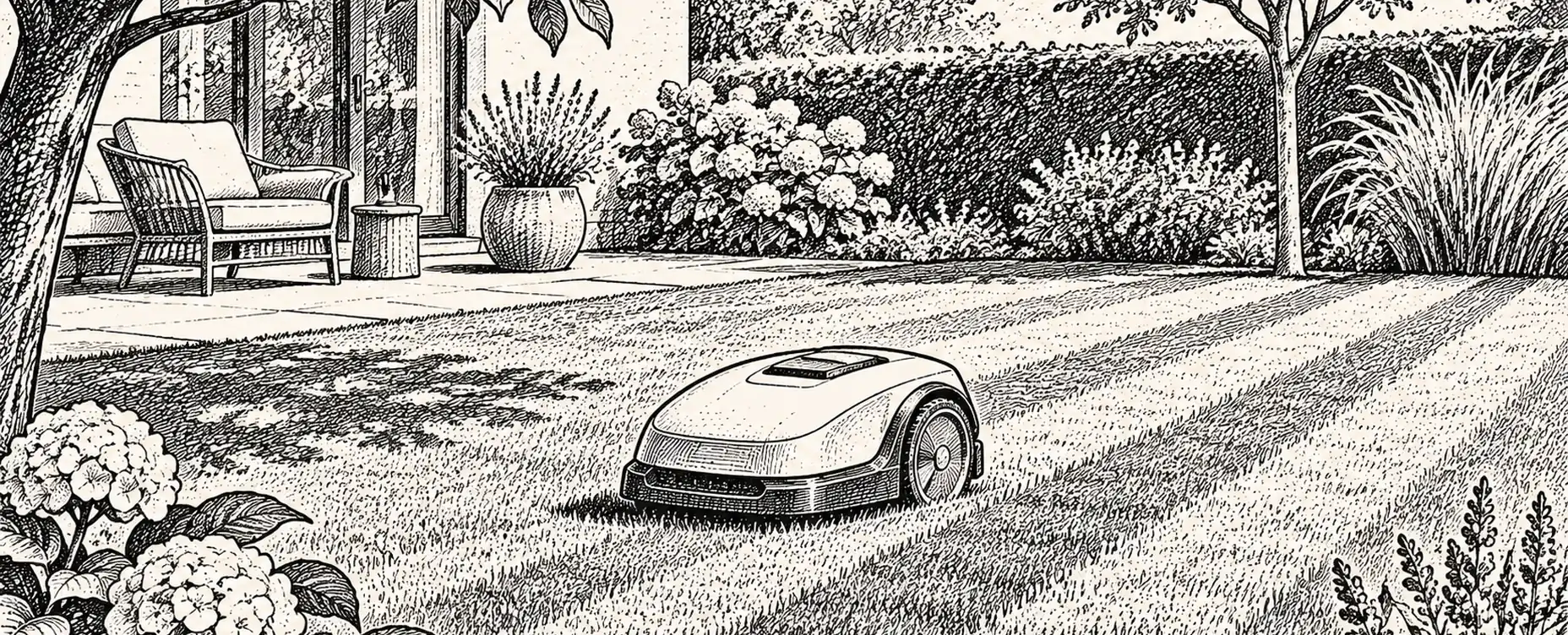
Robot mowers split into two navigation approaches with very different installation costs. Wire-guided models (the longer-established approach, still used by Husqvarna's and Gardena's core ranges) need a boundary wire buried or pegged around the lawn's perimeter, a proper afternoon-to-weekend job depending on garden size and complexity. Wire-free models (increasingly common, led by Husqvarna's EPOS system, Ecovacs Goat, Mammotion Luba and Segway Navimow) use GPS/RTK positioning and a virtual boundary set in an app, cutting installation to under an hour but generally at a higher purchase price.
Slope tolerance is the single most important spec to check against your actual garden, not a marketing headline. Every model has a maximum slope rating (commonly expressed as a percentage or degrees), and a mower that can't handle a garden's steepest section will either fail to cut it or, worse, lose traction and stall there repeatedly.
This is also a genuinely seasonal purchase: expect to store the mower over winter in most of Europe, and factor in the boundary wire or virtual-boundary setup as a one-time cost or time investment that doesn't repeat, unlike most other categories on this site where installation is trivial.
Wire-guided models need a boundary wire installed around the lawn's perimeter and any obstacles, a real but one-time installation job. Wire-free models use GPS with RTK correction for centimetre-level accuracy and a virtual boundary drawn in an app, installing much faster at a higher purchase price.
Stated as a maximum percentage grade or degrees; check this against your garden's steepest section specifically, not an average across the whole lawn, since a mower that stalls repeatedly on one slope is a mower that needs manual intervention constantly.
Manufacturer size ratings assume a reasonably simple, contiguous shape. Narrow passages between wider areas, multiple separate lawn sections, and heavily obstacle-dense gardens (many trees, beds, ornaments) all reduce a model's effective coverage well below its rated maximum area.
Most models pause or reschedule automatically when rain is detected, both to protect the cutting mechanism and because wet-grass cutting quality is poor. Confirm this is standard rather than assumed.
A wider adjustable height range suits gardens that get left longer between cuts or want a lower manicured look. Mulching (fine clippings left on the lawn rather than collected) is standard on almost every current model and generally beneficial for lawn health if cutting is frequent enough.
Since these sit outdoors and unattended, a PIN lock, GPS tracking, and an audible alarm on lift/tilt are worth checking for, particularly for a garden visible from the street or a shared/communal outdoor space.
| Brand | Model | Navigation | Max slope | Max area | Indicative price |
|---|---|---|---|---|---|
| Husqvarna | Automower (wire-guided range) | Wire-guided | up to 70% | up to 5,000 m² | €1,000–3,500 |
| Husqvarna | Automower Aspire (EPOS, wire-free) | GPS/RTK (EPOS) | up to 40% | up to 3,200 m² | €2,000+ |
| Gardena | Smart Sileno | Wire-guided | up to 35% | up to 2,500 m² | €600–1,800 |
| Worx | Landroid | Wire-guided (some wire-free variants) | up to 35% | up to 1,000 m² | €600–1,400 |
| Ecovacs | Goat | GPS/RTK, wire-free | up to 45% | up to 3,000 m² | €1,800+ |
| Mammotion | Luba | GPS/RTK, wire-free | up to 70% | up to 4,000 m² | €2,200+ |
Prices move constantly and vary by country, so we give an indicative band rather than a figure that would be stale within a month. Check the brand's own store for the current price.
Husqvarna essentially defined this category and its wire-guided Automower range remains the benchmark for slope handling — the higher-end models tolerate genuinely steep gardens that rule out most wire-free competitors.
The boundary wire installation is a real time investment, and the range spans a wide price bracket depending on lawn size and features, so it's worth sizing the specific model to the actual garden rather than the brand name alone.
Husqvarna's wire-free EPOS system brings the brand's reputation to a no-wire installation, using a base station for RTK correction and an app-drawn virtual boundary, cutting setup time dramatically versus the wire-guided range.
Slope tolerance on the wire-free line is noticeably lower than the flagship wire-guided models, so it's not simply a strict upgrade — check which characteristic (installation speed or slope handling) matters more for your specific garden.
Gardena (a very familiar name in European gardens generally, and already a natural fit for this site's outdoor-category angle) offers a well-priced, reliable wire-guided range that covers small to medium gardens well without Husqvarna's premium pricing.
It integrates with Gardena's own smart garden app and, via Gardena's smart system gateway, with a broader home automation setup, which is a nice touch most pure-mower brands skip.
Landroid is the accessible entry point into the category, and Worx has increasingly added wire-free navigation to parts of the range, at a price point below the premium brands.
Coverage area and slope tolerance are both more modest than the pricier alternatives here, making it the right fit for a smaller, simpler garden rather than a large or steeply sloped one.
Ecovacs brings its robot-vacuum-honed navigation and app polish to lawn mowing with the Goat range, offering wire-free setup and genuinely capable obstacle avoidance for garden furniture, trees and beds.
As a newer entrant to mowing specifically (versus Husqvarna's decades of lawn-specific engineering), long-term reliability data is still accumulating relative to the established garden-equipment brands.
Luba stands out on slope tolerance among wire-free models specifically, claiming figures that compete with Husqvarna's wire-guided flagships while keeping the fast, no-wire installation of the RTK approach — a genuinely unusual combination in this category.
It's a newer brand without the decades-long service network of Husqvarna or Gardena, so factor in spare-parts and support availability in your specific country before committing.
Wire-guided is cheaper to buy and generally offers better slope tolerance at a given price point, at the cost of a real installation job. Wire-free (GPS/RTK) installs in under an hour and is easier to reconfigure later, at a higher purchase price and, on many models, a lower slope tolerance than the wire-guided equivalent tier.
It varies widely by model, commonly from around 35% up to 70% on the most capable wire-guided flagships. Check the maximum slope rating against your garden's steepest single section, not an average across the whole lawn, since that steepest point is where a mismatched mower will struggle.
Some do, via a connecting corridor or a secondary zone the mower is guided through, but narrow passages and multiple separate lawn areas reduce effective coverage below the model's rated maximum area. Check the manufacturer's specific guidance for split or complex gardens before assuming full compatibility.
In most of Europe, yes — grass growth stops and freezing conditions aren't good for the battery or cutting mechanism, so overwintering indoors with a spring service is standard practice for the category.
Nearly all current models pause automatically when rain is detected, both because wet-grass cutting quality is poor and to protect the cutting mechanism and electronics. This is generally standard rather than a premium-only feature.
More terms in the smart home glossary.