Best Buys › Door & Window Sensors
Door & Window Sensors
Two parts, one job — so the real decisions are size, battery life and how well it hides.
Best Buys › Door & Window Sensors
Two parts, one job — so the real decisions are size, battery life and how well it hides.
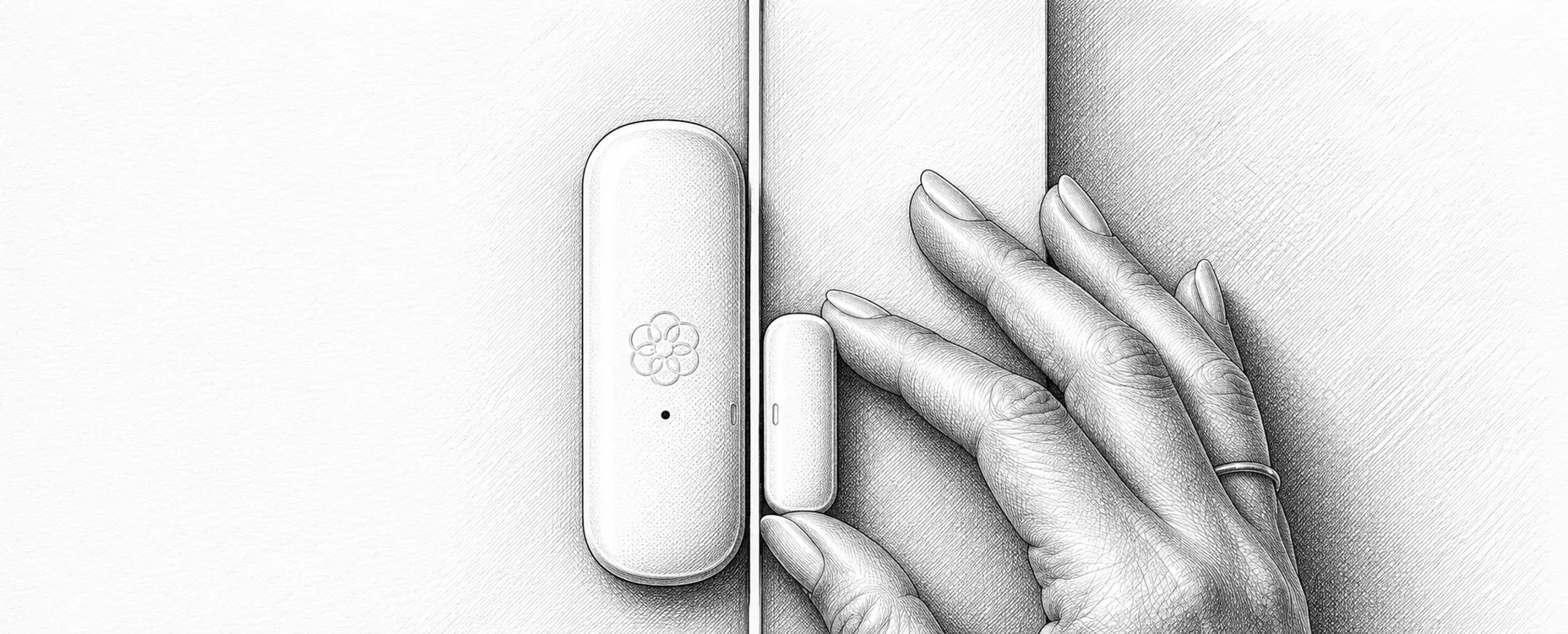
A contact sensor is about as simple as a smart device gets: a body with a radio, and a magnet. Separate the two — by opening a door or window — and it reports the change. There is very little functional variation between models, which is genuinely liberating, because it means you can choose on the things you can see: how big it is, what battery it takes, how long that battery lasts, and whether it disappears against your door frame.
They are also the most useful cheap sensor in a house, and not only for security. A contact sensor on a window pauses the radiator in that room. One on a fridge door catches it being left open. One on a garage side door tells you the thing you always forget. One on a medicine cupboard is quiet child safety. Buy several.
Two specifications deserve more attention than they usually get. Protocol determines reliability — Zigbee and Z-Wave devices join a mesh and are relayed by your mains-powered devices, Bluetooth models need a hub in range, and Thread models need a border router. And physical length matters more than you would expect: a 77 mm sensor looks absurd on a narrow uPVC window frame, however good its specification.
This is the decision you will live with visually. Measure the flat area on your frame before ordering. Several models come in black, white or wood tones, and one is thin enough to be effectively invisible.
The range here is enormous — one year to ten. Just as important is which cell: common AAA and CR2032 cells you already own beat a CR123A you have to order. One model on this list cannot have its battery changed at all without soldering.
Zigbee and Z-Wave are the dependable choices and benefit from your mesh. Bluetooth is cheap but short-range and needs a hub nearby. Thread is the newest and needs a border router. For a shed or gate at the end of a garden, 433 MHz travels much further than any of them.
Several contact sensors also report temperature, vibration or tilt at no extra cost, which effectively makes them two devices. Anti-tamper detection — an alert if the unit is prised off its mount — is worth having if this is genuinely for security.
Adhesive pads are fine on smooth painted or uPVC frames and fail on textured or dusty surfaces. Screw mounting is more secure. One model recesses into the frame entirely, which requires drilling but is completely concealed.
Costs multiply fast. Twelve windows at €40 each is €480; at €20 each it is €240. Decide whether you are securing the house or just triggering automations, because the answer changes which tier makes sense.
| Brand | Model | Protocol | Battery | Claimed life | Extra sensors | Indicative price |
|---|---|---|---|---|---|---|
| Shelly | BLU Door/Window | Bluetooth | CR2032 | 5 years | Tilt, temperature | €20 |
| ThirdReality | Door/Window Sensor | Zigbee | 2 × AAA | 2 years | — | €20 |
| Ring | Contact Sensor v2 | Z-Wave | 2 × CR2032 | 3 years | — | €26 |
| Arre | Tuo Contact Sensor | Matter over Thread | CR2450 | 2 years | — | €27 |
| frient | Entry Sensor Pro | Zigbee | AAA | 9 years | Temperature, vibration, tamper | €30 |
| SwitchBot | Contact Sensor | Bluetooth | 2 × AAA | 3 years | — | €30 |
| Aqara | Door and Window Sensor P2 | Matter over Thread | CR123A | 3 years | — | €33 |
| Zooz | ZSE41 Open/Close | Z-Wave | CR2032 | 1 year | Optional outdoor case | €38 |
| Aeotec | Recessed Door Sensor 7 | Z-Wave | — | 3 years | Fully concealed | €38 |
| Eve | Door & Window | Matter over Thread | ER14250 | 1 year | — | €40 |
| Fibaro | Door/Window Sensor 2 | Z-Wave | ½ AA | 2 years | Temperature, tamper | €40 |
| Sensative | Strips Guard 800 | Z-Wave | Sealed | 10 years | Weatherproof to −30 °C | €40 |
| Philips Hue | Secure Contact Sensor | Zigbee | — | 2 years | — | €40 |
Prices move constantly and vary by country, so we give an indicative band rather than a figure that would be stale within a month. Check the brand's own store for the current price.
The best all-round pick for most homes. It is the smallest sensor here, comes in three finishes so it actually disappears against a frame, and manages five years on a single common coin cell — while also reporting tilt and temperature, which most rivals at twice the price do not.
The trade-off is Bluetooth: it does not join a mesh, so it needs a hub or Bluetooth-capable device within range. In a normal house that is a non-issue; in a large or thick-walled one, check coverage before buying twelve.
If battery maintenance is what you dread, this is the answer. Nine years sounds implausible until you understand that battery-powered Zigbee devices spend almost all their time in deep sleep — and frient uses AAA cells rather than a coin cell, giving it far more capacity to work with.
The vibration sensor makes it a better security device than a plain contact, because it detects a window being forced while still closed. The shape is the compromise: long, thin and white, which is invisible on white uPVC and obvious on oak.
The choice when the sensor must not be visible. At 3 mm thick it follows the line of the frame and genuinely disappears — which is why architects and interior designers specify it. It is also properly weatherproof and works to −30 °C, so it covers garden gates, sheds and outbuildings.
The ten-year battery is sealed. When it eventually dies, replacing it requires soldering, so in practice treat this as a ten-year consumable. At around €40 that is €4 a year, which is reasonable for something invisible.
The future-proof pick. Matter over Thread means it pairs directly with a Thread-capable hub and will keep working as ecosystems change. The larger CR123A cell buys three years of life, and the supplied slim magnet makes it usable on metal surfaces where an adhesive pad alone would struggle.
Its one flaw is length — 77 mm is a lot of sensor. Measure your narrowest frame first. Worth noting that Aqara’s previous-generation Zigbee sensor remains one of the best small contacts ever made, and is cheaper if you do not need Thread.
This one sits inside a hole drilled in the frame, so once the door is closed there is nothing to see at all. If a visible sensor is unacceptable and 3 mm is still too much, this is the option — at the cost of a drill and a careful afternoon. Aeotec also makes a Zigbee multipurpose version that adds vibration, tilt and temperature.
Fibaro solves the visibility problem differently: rather than making the sensor small, they make it available in seven colours so it matches the frame. Match it correctly and the size stops mattering. Build quality and Z-Wave stability are both excellent, and the built-in temperature sensor doubles its usefulness.
The security-focused Z-Wave pick. S2 encryption and SmartStart pairing make it a good fit if the point of the exercise is genuinely protecting the house rather than triggering lights. Zooz sells a weatherproof case for outdoor use. The one-year battery life is the weak point, so budget for annual changes.
Beautifully made and completely reliable, with a status indicator built into the button in the middle. It is also the least featured sensor here at the highest price, with no temperature, tilt, vibration or tamper detection. Buy it if you already run Hue and want everything in one app; otherwise the value is hard to justify.
Zigbee, Z-Wave and Thread all operate at low power and rely on a mesh of relaying devices. None of that helps at a gate 60 metres down the garden with no mains power in between.
For those, look at 433 MHz sensors from brands such as Telldus, Trust (KlikAanKlikUit) and Cleverio. The lower frequency travels considerably further and penetrates walls better, they run on common batteries, and they cost very little. The compromise is that most are one-way — they report an opening but cannot be queried — and they lack encryption, so use them for convenience automations rather than as the sensor your alarm depends on.
Anywhere from one to ten years depending on the model, the cell and how often the door is used. Devices using AA or AAA cells last far longer than coin-cell models simply because of capacity — frient claims nine years on AAA, while several coin-cell sensors manage one. A sensor on a front door used forty times a day will drain faster than one on a rarely opened window.
Zigbee or Z-Wave for reliability in a normal house, because both benefit from mains-powered devices relaying their traffic. Bluetooth models are cheaper but need a hub within range. Thread is the most future-proof and needs a border router, which most modern hubs provide. For outbuildings, 433 MHz reaches much further than any of them.
They can form part of one, but choose carefully. For security use, look for encryption (Z-Wave S2 is the benchmark) and tamper detection that alerts if the unit is removed from its mount. A plain unencrypted 433 MHz sensor is fine for automation and unsuitable as the basis of an alarm.
Yes, but adhesive pads perform poorly on cold metal and the magnet interacts with the frame. The Aqara P2 ships with a slim magnet specifically for this, and several models can be screw-mounted instead. On aluminium frames, test one before committing to a dozen.
A great deal. Pausing a radiator when a window opens, alerting when a fridge or freezer door is left open, catching a garage side door left ajar, monitoring a medicine or chemical cupboard, or simply turning on a light when a cupboard opens. They are among the most versatile cheap devices you can buy.
More terms in the smart home glossary.