Best Buys › Air Purifiers
Air Purifiers
Match CADR to room size first — an undersized purifier on its highest setting still won't out-clean an oversized one on low.
Best Buys › Air Purifiers
Match CADR to room size first — an undersized purifier on its highest setting still won't out-clean an oversized one on low.
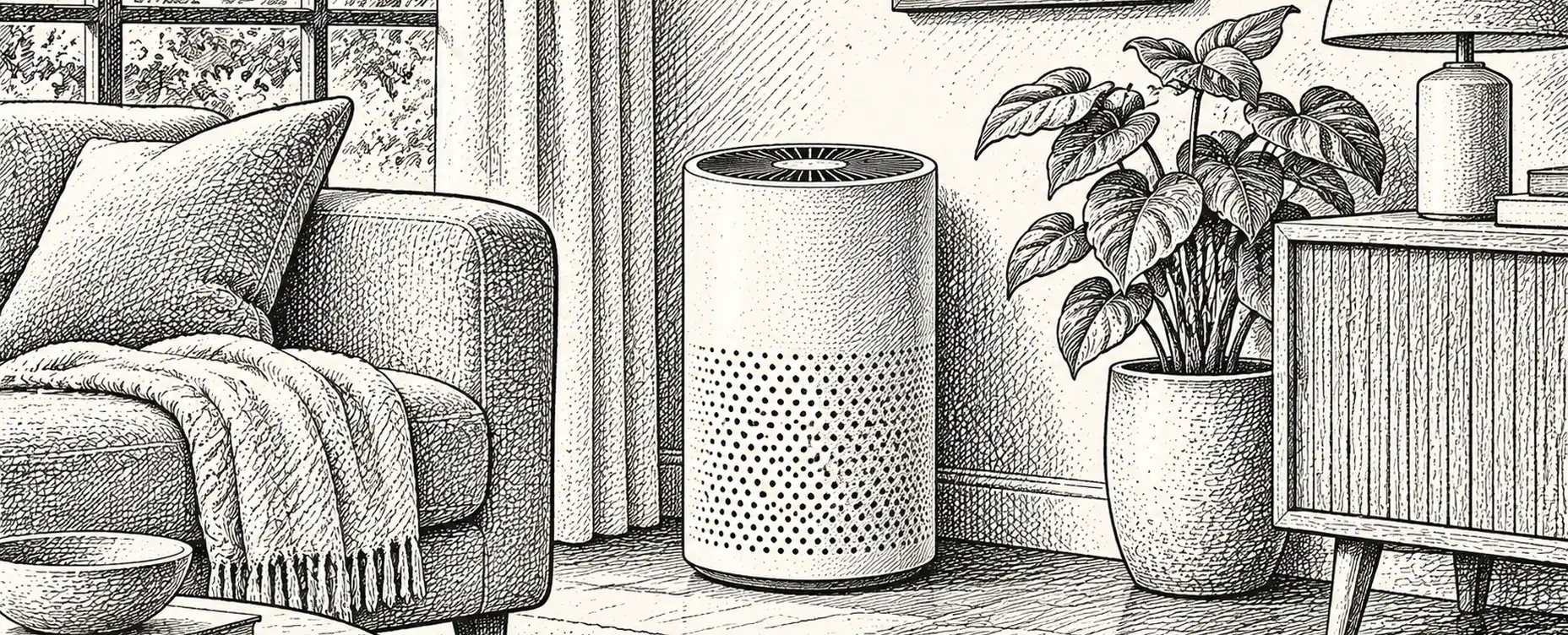
An air purifier's real-world performance comes down to two numbers most buyers skip: CADR (Clean Air Delivery Rate, how much filtered air it actually moves per hour) matched against the room's actual size, and the ongoing filter replacement cost over the unit's lifetime, which for a cheap purifier can exceed the purchase price within a couple of years.
The category splits broadly into HEPA-filter models (the standard for genuine particulate removal, including allergens, dust and smoke) and models that add activated carbon (for odours and some VOCs) or, on a few higher-end units, additional sensors for automatic speed adjustment based on measured air quality rather than a fixed schedule.
This site's allergies and asthma article and indoor air quality article cover the health case for filtration in more depth; this guide is about matching a specific purifier to a specific room.
Manufacturers state a recommended room size for each model, usually alongside the raw CADR figure. Buying for the room it will actually sit in, not the biggest room in the house on the assumption it'll get moved around, gives a far more accurate expectation of real performance.
A genuine HEPA filter (removing at least 99.95% of particles down to 0.3 microns under the European EN 1822 standard, or a broadly equivalent claim) is the baseline worth checking for explicitly; some budget units use a lesser "HEPA-type" or "HEPA-like" filter that doesn't meet the actual standard.
Add up the manufacturer's recommended filter replacement interval and current replacement filter price over two to three years of ownership; this ongoing cost varies enormously between brands and can flip which model is actually cheaper overall.
A separate or combined activated carbon layer targets odours and some volatile organic compounds that a HEPA filter alone, which is a purely particulate filter, doesn't address. Worth prioritising for cooking odours, pet smells, or a home near a busy road with traffic fumes.
The most useful automation adjusts fan speed based on an actual onboard particulate sensor's reading, ramping up when air quality drops and idling quietly the rest of the time. A cosmetic colour-changing light ring that isn't tied to a real sensor reading is a lesser feature, worth distinguishing from genuine auto mode.
Check decibel ratings at the speed setting realistic for continuous use (often the lowest one or two settings), not just the headline maximum-speed figure, particularly for bedroom placement.
| Brand | Model | Filtration | Room size | Auto mode sensor | Indicative price |
|---|---|---|---|---|---|
| IKEA | STARKVIND | True HEPA + activated carbon | up to ~32 m² | No (basic 3-speed) | €100–170 |
| Philips | Series 3000i / 2000i | True HEPA + activated carbon | up to ~49–79 m² | Yes, real-time PM sensor | €250–400 |
| Xiaomi/Smartmi | Air Purifier 4 series | True HEPA | up to ~48 m² | Yes, real-time PM sensor | €150–250 |
| Levoit | Core series | True HEPA + activated carbon | up to ~50–65 m² | Yes on higher tiers | €120–250 |
| Blueair | Blue series | HEPASilent (proprietary) | up to ~50–80 m² | Yes, real-time PM sensor | €250–450 |
Prices move constantly and vary by country, so we give an indicative band rather than a figure that would be stale within a month. Check the brand's own store for the current price.
IKEA's purifier is the accessible entry point with genuine true-HEPA filtration and, unusually for the price tier, a version that doubles as a side table, at a price well below the premium brands.
It lacks a real-time particulate sensor for genuine auto mode, running on a basic 3-speed setting instead, and Zigbee integration via IKEA's DIRIGERA hub is a nice touch for existing IKEA smart home users specifically.
Philips' purifiers pair genuine true-HEPA and activated carbon filtration with a real-time particulate sensor driving a genuinely responsive auto mode, and the app clearly displays current measured air quality rather than a vague indicator light.
It's priced at a premium over IKEA and Xiaomi for a comparable room-size rating, reflecting the more capable sensor and generally more polished build.
Xiaomi's range undercuts Philips and Blueair on price while still including a genuine real-time particulate sensor and true-HEPA filtration, making it a strong value pick for a mid-sized room.
App and account setup goes through Xiaomi's ecosystem, which some buyers find less polished or trust-inspiring than Philips' or Blueair's, and third-party smart-home integration varies by exact model and region.
Levoit has built a strong reputation for straightforward, reliable purifiers at a competitive price, with true-HEPA and activated carbon filtration standard across the range and a real-time sensor on the higher tiers specifically.
The entry-level Core models in the range skip the real-time sensor, so check the exact model tier rather than assuming the whole Core range includes it.
Blueair's proprietary HEPASilent filtration combines mechanical and electrostatic filtering to achieve strong particulate removal at a lower noise level than many pure-mechanical HEPA competitors at a comparable CADR, which matters for continuous bedroom or office use.
It's priced at the premium end of this comparison, and Blueair's washable pre-filter is a nice ongoing-cost saver, though the main HEPASilent filter itself still needs periodic replacement.
Check the manufacturer's stated recommended room size for the specific model, which is usually based on achieving a reasonable number of air changes per hour at that room's volume, and buy for the room it will actually live in rather than the largest room in the house.
For genuine particulate removal (allergens, fine dust, smoke), yes — look specifically for a stated "true HEPA" or EN 1822 compliance claim rather than a vaguer "HEPA-type" or "HEPA-like" description, which doesn't guarantee the same filtration standard.
It varies enormously by brand and model, and is worth calculating over two to three years of ownership rather than judging on purchase price alone — a cheaper purifier with frequent, expensive filter replacements can end up costing more overall than a pricier model with a longer filter life.
Running a correctly sized purifier continuously on a lower, quieter setting generally achieves better average air quality than running an undersized one occasionally on its highest, loudest setting. Continuous low-level operation is usually the more effective and more livable approach.
A HEPA filter alone targets particulates, not gases or odours. A separate or combined activated carbon layer is what actually addresses cooking smells, pet odours and some volatile organic compounds, so check for it explicitly if odour control specifically is a priority.
More terms in the smart home glossary.