Best Buys › Air Conditioners
Air Conditioners
Cooling and heating you can schedule — and the one category where you probably should not replace what you already own.
Best Buys › Air Conditioners
Cooling and heating you can schedule — and the one category where you probably should not replace what you already own.
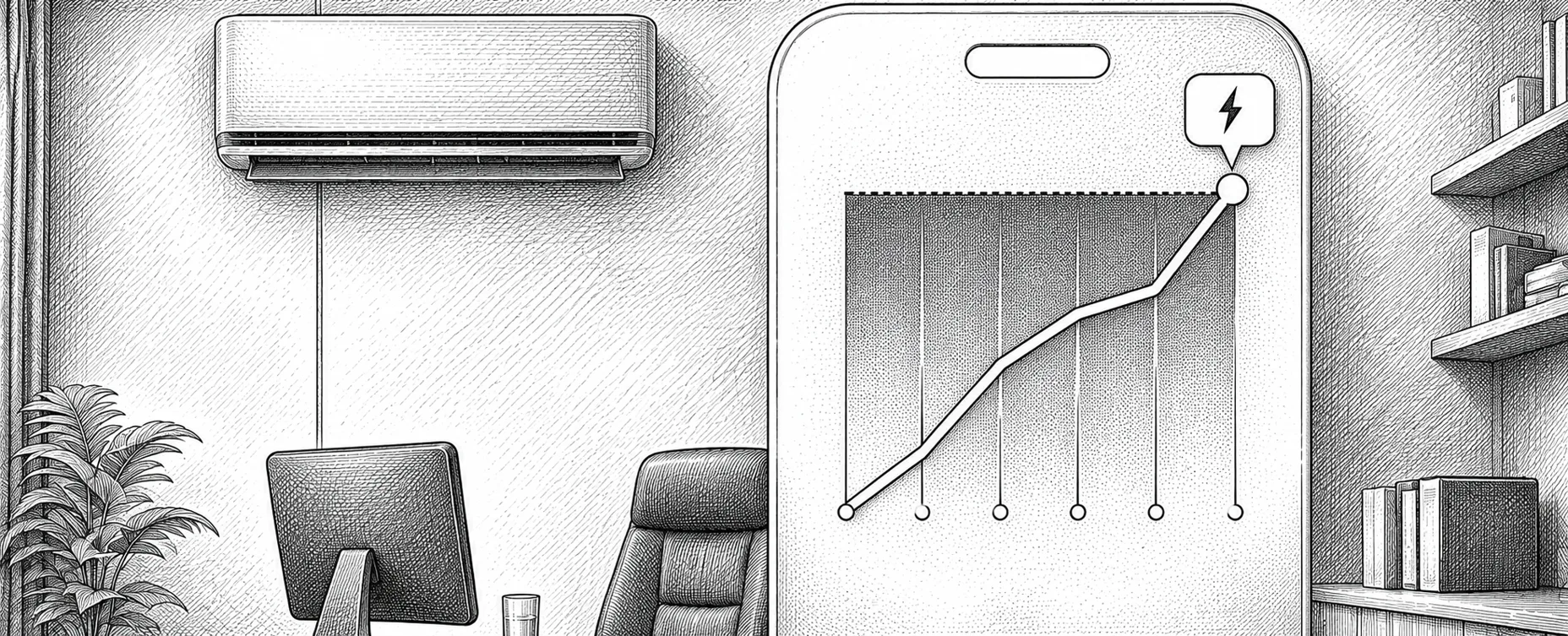
An air conditioner is one of the largest electrical loads in a house, so putting it on a schedule and tying it to occupancy has a bigger effect on a bill than almost any other automation. Modern units are also heat pumps in reverse, which means the same box that cools in August heats efficiently in March.
Start with the honest advice: if your existing air conditioner works, do not replace it to make it smart. Almost every AC ever sold accepts an infrared remote, and an infrared blaster — a device that mimics those remote signals — will bring it under app and automation control for a fraction of the cost of a new unit. Several smart home hubs have one built in, and a standalone unit like the Sensibo Air handles the rest.
If you are buying new, the decision splits three ways. What type of unit suits the building, how efficient it is, and whether it connects over Wi-Fi natively or needs the infrared route. The last one matters less than people assume: infrared control is one-way, so the system cannot always read the unit’s true state, but for scheduling and occupancy automation it is perfectly adequate.
Split systems (an indoor unit plus an outdoor compressor) are the default for houses — effective and quiet. Multi-split runs several indoor units off one outdoor unit. Ducted hides everything in ceilings or walls for whole-house cooling. Cassette units mount in a suspended ceiling. Window and portable units need no installation but are noisier and less efficient.
This is the number that decides your running cost. Look for the highest efficiency class available — A+++ where it is offered — and treat everything else as secondary. An inverter compressor, which varies its speed rather than switching on and off, is the single biggest contributor.
Some integrations only offer on/off and a target temperature. Better ones expose fan speed, operating mode, and horizontal and vertical vane direction. If you plan automations more sophisticated than a timer, check what is actually controllable rather than what the app screenshot shows.
Most Wi-Fi air conditioners route through the manufacturer’s cloud, which means an internet outage takes your heating and cooling with it. Gree is unusual in offering a genuinely local connection, and infrared control is inherently local.
A split system is fixed plant with refrigerant lines. It needs professional installation, periodic servicing, and a manufacturer who will still be answering the phone in eight years. Weight this more heavily than you would for a plug or bulb.
Cheaper units are noticeably louder, and the outdoor unit is what will annoy a neighbour. Published sound figures in decibels are comparable between brands and worth reading.
| Brand | Connection | Fixed systems | Window | Portable | Local control | Indicative price |
|---|---|---|---|---|---|---|
| Sensibo Air | Wi-Fi + infrared | Yes | Yes | Yes | Infrared, local | €120 (retrofit) |
| Gree | Wi-Fi | Yes | Yes | Yes | Yes, local API | €500+ |
| LG ThinQ | Wi-Fi | Yes | Yes | Yes | Cloud | €600+ |
| Toshiba | Wi-Fi | Yes | Yes | Yes | Cloud | €600+ |
| Panasonic Comfort Cloud | Wi-Fi | Yes | No | Yes | Cloud | €700+ |
| Mitsubishi Heavy Industries | Infrared | Yes | No | No | Infrared, local | €700+ |
| Daikin ONECTA | Wi-Fi | Yes | No | No | Cloud | €800+ |
| Mitsubishi Electric | Infrared | Yes | No | Yes | Infrared, local | €900+ |
Prices move constantly and vary by country, so we give an indicative band rather than a figure that would be stale within a month. Check the brand's own store for the current price.
Read this row first, because for most people it is the answer. Sensibo Air sits on the wall, learns your air conditioner’s infrared remote codes, and turns a dumb unit into a scheduled, geofenced, automatable one for around a tenth of the cost of replacing the hardware. It supports mini-split, window, ductless, portable and even some central systems.
It also adds what the AC never had: presence-based control, filter-cleaning alerts, and on the Air Pro, sensors for CO2 and volatile organic compounds so cooling can respond to air quality. The only real cost is that each air conditioner needs its own unit.
Gree is the value pick and, unusually, the technically cleanest: control is local, so responsiveness is good and an internet outage does not take your cooling with it. Because Gree units use the EWPE Smart platform, the same integration also picks up Argo, Tosot, Cooper & Hunter, Daitsu, Innova and Wilfa — a lot of European brands are Gree underneath.
The budget Lomo and Pular series do the job cheaply; the U-Crown is the efficient premium option. Expect fan noise on the cheaper units.
Daikin is the quality benchmark for split systems, and the ONECTA platform covers a broad range — Emura, Perfera, Stylish, Sensira, Comfora and the premium Ururu Sarara — in split, multi-split, ducted and cassette forms. Some heat pumps are controllable through the same app.
Two practical notes: onboarding must happen in the ONECTA app before any other system can see the unit, and control runs through Daikin’s cloud, so an outage means falling back to the remote.
LG is the range pick: split, multi-split, ducted, cassette, window and portable all exist, so whatever the building needs, there is an LG that fits. DualCool Deluxe and ArtCool Mirror are the efficient premium lines; the standard DualCool covers the budget end.
The ARTCOOL Gallery deserves a mention purely for solving the aesthetic problem — it is a wall-mounted unit with a customisable display panel that looks like a picture frame, which is a far better answer to “I do not want a white box on my wall” than anything else on the market.
The MSZ-LN and MSZ-AP series are about as good as residential air conditioning gets: plasma quad filtration, efficient inverter compressors, and genuinely quiet running. Control is over infrared rather than Wi-Fi, which keeps it local but limits you to power, target temperature and mode.
Worth knowing that Mitsubishi Electric and Mitsubishi Heavy Industries are separate companies despite the shared name — Electric focuses on consumer appliances, Heavy Industries on industrial plant with a residential sideline.
Panasonic’s strength is air treatment: the Etherea range’s nanoe™ X system actively neutralises bacteria and allergens rather than merely filtering, which is a genuine differentiator if anyone in the house has allergies. The TZ series is the sensible budget line.
Toshiba sits between the budget and premium tiers. The Seiya line is the value option; the Daiseikai adds quieter running, better efficiency, three-stage filtration and motion-guided airflow — plus an ash wood finish, which is unusual in a category obsessed with white plastic. Some models report energy consumption, which is rare here and useful.
An infrared blaster reproduces the signals your existing remote sends. Because almost every air conditioner ever made accepts an infrared remote, this works on hardware decades old — and several smart home hubs include a blaster, so the marginal cost can be nothing at all.
The trade-off is that infrared is one-way. Your system can tell the unit what to do but cannot read back what state it is in, so if someone uses the handheld remote, the two go out of sync until the next command. In practice this matters far less than it sounds: schedules, geofencing and “turn off when the window opens” all work perfectly, because they only ever send commands. Pair it with a temperature sensor in the same room and you have closed-loop control anyway — the sensor tells you the truth about the room, which is what you actually care about.
Yes, and it is usually the right call. An infrared blaster reproduces your remote’s signals and works on almost any air conditioner regardless of age. A dedicated unit such as Sensibo Air supports over 10,000 models, and some smart home hubs have a blaster built in, making the upgrade nearly free.
A split system pairs one indoor unit with one outdoor compressor. A multi-split runs several indoor units from a single outdoor unit, which saves outdoor space and is neater on a facade when you want to cool several rooms.
For automation, almost as well. The limitation is that infrared is one-way, so your system cannot read the unit’s current state and can drift out of sync if someone uses the handheld remote. Adding a room temperature sensor closes that gap, because you then measure the outcome rather than trusting the setting.
With infrared control or Gree’s local connection, yes. Most other Wi-Fi air conditioners route commands through the manufacturer’s cloud, so an outage leaves you using the physical remote until service returns.
Nearly all modern units can, by running the refrigeration cycle in reverse — they are heat pumps. In mild weather this is often cheaper per unit of heat than a gas boiler, which makes an air conditioner a more sensible year-round purchase than the name suggests.
More terms in the smart home glossary.